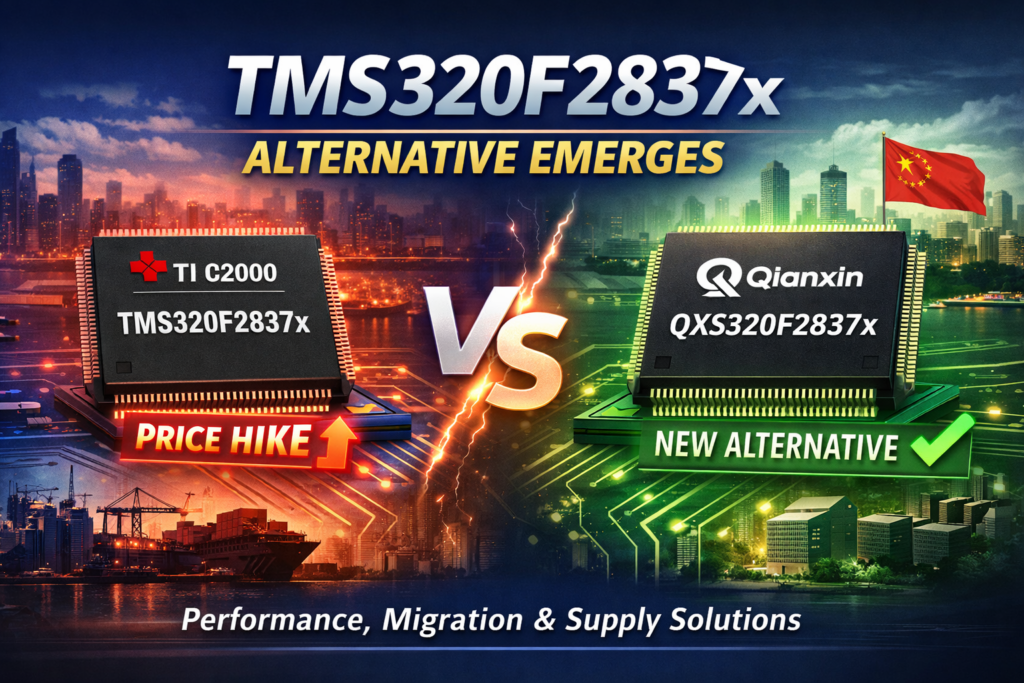
We’re seeing a strong TI TMS320F2837x alternative now. In early March, news of a price increase from Texas Instruments (TI), a leading analog and embedded semiconductor manufacturer, sent shockwaves through the industry.
Following the announcement, spot market prices for general-purpose chips rose sharply. Some high-demand models experienced rapid price fluctuations, with certain components even doubling in price within a short period. Among the most affected were widely used devices such as the TMS320F28335 and TMS320F28377, both part of TI’s well-established C2000 series.
Despite being introduced nearly three decades ago, these chips continue to rank among the most searched and widely adopted solutions in real-time control applications.
This raises an important question:
Why does a 30-year-old architecture still dominate, and what is finally beginning to challenge it?
The Real Strength Behind TI’s C2000 Ecosystem
The long-term success of TI’s C2000 series is not driven by specifications alone. Its true competitive advantage lies in a deeply established ecosystem.
Over nearly 30 years, TI has built:
- A mature and stable development toolchain
- Extensive documentation and application resources
- A large and experienced engineering community
- High levels of developer familiarity and trust
For many engineering teams, adopting C2000 is not just a technical choice, but a practical one. Once a system is built around it, switching platforms involves significant redevelopment effort, including hardware redesign, software migration, and system revalidation.
This high switching cost has been one of the main reasons why the platform has remained dominant for so long.
Market Pressure Is Reshaping the Landscape
However, the environment surrounding semiconductor supply chains has changed significantly in recent years.
Since the China–United States trade war, global supply chains have become increasingly uncertain. This was further intensified during the 2021 global chip shortage, when long lead times and supply instability forced many manufacturers to reassess their sourcing strategies.
As a result, the demand for localized and diversified supply options has increased.
In lower-end segments, domestic semiconductor manufacturers have already achieved substantial progress, covering approximately 70–80% of product categories traditionally dominated by international suppliers.
However, in high-end real-time control DSP applications, progress has been much slower due to higher technical barriers and stronger ecosystem lock-in.
Why DSP Substitution Has Been So Difficult
Digital Signal Processors (DSPs) play a critical role in applications that require high-speed, real-time processing, such as:
- Industrial motor control
- Digital power systems
- Photovoltaic inverters
- Electric vehicle control systems
These applications demand not only high performance, but also long-term stability and reliability. Any change in core components requires extensive validation and carries inherent risks.
In addition to technical challenges, DSP substitution has been constrained by:
- Software migration complexity
- Development tool compatibility
- Limited ecosystem support from alternative vendors
Historically, these factors have made it difficult for new entrants to gain traction in this segment.
A Practical TMS320F2837x Alternative Emerges
Recently, a notable development has begun to change this dynamic.
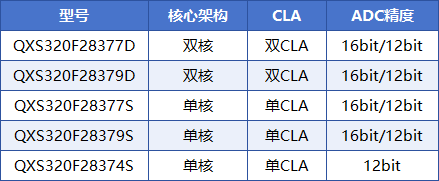
合肥乾芯科技有限公司 has introduced the QXS320F2837x series, positioned as a direct TMS320F2837x alternative for high-end real-time control applications.
Unlike previous attempts at substitution, this series focuses not only on performance parity, but also on reducing migration barriers and ensuring supply stability.
Performance That Meets and Exceeds Expectations
From a technical perspective, the QXS320F2837x series delivers competitive, and in some areas superior, performance compared to its TI counterpart.
Key improvements include:
- Dual-core architecture running at 240MHz (compared to 200MHz)
- Integrated acceleration units including FPU, TMU, VCU-II, and CLA
- 2MB on-chip Flash and 2MB RAM, significantly exceeding comparable models
- Enhanced peripheral integration, including high-precision ADCs, expanded PWM channels, and CAN FD support
These enhancements directly benefit real-time control systems by improving processing efficiency, reducing latency, and enabling more complex control algorithms.
Lower Migration Cost: A Critical Advantage
One of the most important factors in DSP substitution is migration cost.
The QXS320F2837x series addresses this directly:
- Pin-to-pin compatibility with TMS320F2837x
- Existing PCB designs can be reused with minimal modification
- High compatibility with C2000 software architecture
- Up to 90% code migration at the application layer
This significantly reduces the engineering effort required to transition from existing TI-based systems, making it a viable option for both new designs and legacy upgrades.
Supply Chain Stability as a Strategic Factor
Beyond performance and compatibility, supply chain reliability has become a key consideration for many organizations.
The QXS320F2837x series is built on a fully self-developed architecture, without reliance on external licensed IP. Combined with domestic manufacturing and packaging capabilities, this enables:
- Greater control over production and delivery timelines
- Reduced exposure to export restrictions and geopolitical risks
- The ability to support long-term supply agreements
In an increasingly uncertain global environment, this level of supply chain control is a significant advantage.
Ecosystem Development and Support
Recognizing the importance of ecosystem readiness, Qianxin has also invested in supporting infrastructure, including:
- Software development kits (SDKs) and driver libraries
- Migration guides from TI platforms
- Reference designs for common applications
- Dedicated Field Application Engineer (FAE) support
These resources are designed to shorten development cycles and reduce the learning curve for engineering teams.
Conclusion: From Possibility to Practicality
For nearly three decades, TI’s C2000 series has maintained its position as a standard platform in real-time control applications.
Its dominance has been driven not only by performance, but by ecosystem strength and high switching costs.
Today, however, the emergence of viable solutions like the QXS320F2837x series signals a shift in the market.
For engineers and procurement teams seeking a TMS320F2837x alternative, the decision is no longer limited by feasibility, but by strategy.
As migration becomes easier and supply considerations become more critical,
the balance between performance, cost, and risk is being redefined.
As the demand for supply chain resilience and cost control continues to grow, relying on a single vendor is becoming increasingly risky for procurement teams.
Solutions like the QXS320F2837x series are no longer just technical alternatives. They represent a more practical approach to balancing performance, cost, and supply stability in real-world projects.
For companies actively evaluating a TMS320F2837x alternative, the key consideration is no longer feasibility, but how quickly and safely the transition can be implemented.
At 7setronic, we support customers not only with component supply, but with complete sourcing solutions, including:
- Alternative component recommendations based on real project needs
- Cost optimization strategies across BOM levels
- Stable sourcing channels for high-risk or long lead-time components
- Engineering support for component evaluation and substitution
By combining supply capability with application-level understanding, we help procurement and engineering teams reduce risk, control cost, and move projects forward with confidence.
FAQ
1. What is a good TMS320F2837x alternative?
A strong TMS320F2837x alternative should offer similar performance, easy migration, and stable supply. The QXS320F2837x series meets these requirements with pin compatibility and high code reuse.
2. Is it hard to replace TI C2000 DSP?
It used to be. But with compatible alternatives, PCB redesign is minimal and up to 90% of code can be reused, making migration much easier.
3. How can procurement reduce DSP supply risk?
Avoid single sourcing, qualify alternatives early, and work with reliable partners like 7setronic to secure supply and pricing.