

Overview
The ATWINC1500-MR210PB1952-T is a low-power Wi-Fi network controller module designed for embedded IoT and wireless connectivity applications.
It is widely used in smart home devices, IoT sensor nodes, and industrial wireless controllers, where secure Wi-Fi connectivity, low power consumption, and fast integration are required.
This module integrates a complete TCP/IP stack and Wi-Fi network services, significantly reducing firmware complexity for host microcontrollers.
Core Parameters
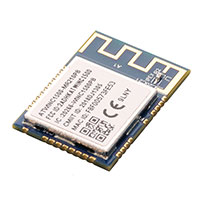
| Parameter | Specification |
|---|---|
| Device Type | Wi-Fi Network Controller Module |
| Wi-Fi Standard | IEEE 802.11 b/g/n |
| Frequency Band | 2.4 GHz |
| Security | WEP, WPA/WPA2-PSK |
| Host Interface | SPI |
| Operating Voltage | 3.0 V to 4.2 V |
| Integrated Stack | TCP/IP, SSL |
| Power Modes | Active, Sleep, Deep Sleep |
| Package Type | Module |
| Temperature Range | -40°C to +85°C |
These parameters make the device suitable for embedded wireless IoT systems, especially where low power operation and simplified Wi-Fi integration are critical.
Features
- Fully integrated Wi-Fi network controller with TCP/IP stack
- Supports secure connections with SSL encryption
- Low-power architecture optimized for battery-powered devices
- Simple SPI interface for host MCU communication
- Certified module reduces regulatory compliance effort
- Designed for seamless integration with Microchip SAM microcontrollers
Typical Application Scenarios
- Smart home and building automation
- IoT gateways and wireless sensor networks
- Industrial monitoring and control systems
- Wearable and portable connected devices
- Remote data acquisition units
The ATWINC1500-MR210PB1952-T is often paired with the ATSAMD21G18A-AU microcontroller in Wi-Fi–enabled IoT designs. The ATSAMD21G18A-AU handles low-power control and application logic, while the ATWINC1500 provides secure wireless connectivity, forming a stable and widely adopted MCU + Wi-Fi solution.
Performance Comparison
| Feature | ATWINC1500 | Discrete Wi-Fi Chip | LTE Module |
|---|---|---|---|
| Integration Level | High (Module) | Low | Medium |
| Power Consumption | Low | Medium | High |
| Firmware Complexity | Low | High | High |
| Cost | Competitive | Lower | Higher |
| Target Use Case | Local Wi-Fi IoT | Custom RF Design | Wide-Area IoT |
Compared with discrete Wi-Fi solutions, the ATWINC1500-MR210PB1952-T offers faster time-to-market and reduced design risk, while maintaining excellent power efficiency.
Conclusion
The ATWINC1500-MR210PB1952-T provides a reliable and secure Wi-Fi connectivity solution for embedded and IoT applications. Its integrated network stack, low power modes, and certified module design make it an ideal companion for Microchip SAM MCUs and other host processors.
Manufacturer Profile

Microchip Technology is a global leader in microcontrollers, connectivity solutions, and embedded control products. Its Wi-Fi modules and network controllers are widely used in IoT, industrial, and consumer electronics, supported by long-term availability and a strong development ecosystem.
FAQ
Q1: Does ATWINC1500-MR210PB1952-T require an external TCP/IP stack?
No. The module includes an integrated TCP/IP and SSL stack, reducing host MCU firmware complexity.
Q2: What microcontrollers are commonly used with this module?
It is frequently paired with Microchip SAM devices such as ATSAMD21 series microcontrollers.
Q3: Is this module suitable for low-power applications?
Yes. It supports multiple sleep modes optimized for battery-powered IoT devices.
Q4: How can I verify the quality of ATWINC1500-MR210PB1952-T?
7SEtronic follows a complete and standardized quality inspection SOP. Each unit is checked through label verification, visual inspection, and X-ray analysis to ensure authenticity and stable performance for your reference.
For more information and to review our available inventory, please contact our team for detailed pricing, current stock levels, and any additional technical support you may need.
You can find more component guides and application notes in our Component Technical Guides section: