

Overview
The LT1990CS8#PBF is a high-speed, low-noise instrumentation amplifier designed for precision signal conditioning applications. It is widely used in industrial sensor interfaces, resolver signal conditioning, and data acquisition systems, where high accuracy, wide bandwidth, and excellent common-mode rejection are required.
This device integrates matched resistors and flexible gain configurations, enabling designers to simplify analog front-end designs while maintaining stable and repeatable performance.
Core Parameters
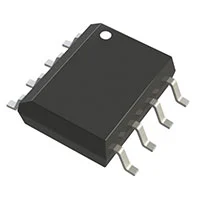
| Parameter | Value |
|---|---|
| Supply Voltage Range | ±5 V to ±15 V |
| Gain Accuracy | ±0.1% |
| Bandwidth | Up to 4 MHz |
| Input Noise Voltage | 7 nV/√Hz |
| CMRR | 80 dB (typical) |
| Package | SOIC-8 |
These parameters make the device suitable for precision analog front-end and sensor signal conditioning, especially where low noise and high bandwidth are critical.
Features
- High-speed instrumentation amplifier architecture
- Excellent DC accuracy with laser-trimmed resistors
- Wide bandwidth for fast-changing signals
- Flexible gain configurations with external resistor options
- Low input voltage and current noise
- Stable performance over temperature
The LT1990CS8#TRPBF is functionally identical, differing only in packaging and tape-and-reel format, making it suitable for automated assembly.
Typical Application Scenarios
- Resolver and encoder signal conditioning
- Industrial sensor interfaces
- Precision data acquisition systems
- Motor control feedback circuits
- Medical and test instrumentation
The LT1990CS8#PBF is frequently used together with the AD698APZ resolver-to-digital converter. It provides precise signal conditioning and amplification for resolver sine and cosine outputs, helping the AD698APZ achieve higher accuracy and improved noise immunity in position and speed measurement applications.
Performance Comparison
Compared with general-purpose operational amplifiers, the LT1990CS8#PBF offers:
- Higher common-mode rejection
- Better gain accuracy without external trimming
- Improved noise performance at higher frequencies
These advantages reduce system calibration effort and improve overall measurement reliability.
Conclusion
The LT1990CS8#PBF delivers a strong balance of precision, speed, and flexibility, making it a reliable choice for demanding analog signal conditioning designs. With multiple gain options and excellent noise characteristics, it helps engineers achieve accurate results while simplifying circuit design.
Manufacturer Profile

Analog Devices, Inc. (ADI) is a global leader in high-performance analog, mixed-signal, and digital signal processing technologies. ADI products are widely used in industrial, automotive, communications, and instrumentation markets, known for long-term reliability and strong technical support.
FAQ
Q1: What type of applications is the LT1990CS8#PBF best suited for?
The LT1990CS8#PBF is optimized for precision signal conditioning applications that require high bandwidth, low noise, and excellent common-mode rejection, such as industrial sensing, data acquisition, and high-speed measurement systems.
Q2: What supply voltages does the LT1990CS8#PBF support?
The device operates from dual power supplies ranging from ±5 V to ±15 V, providing flexibility for a wide range of analog front-end designs.
Q3: What makes the LT1990CS8#PBF stand out in terms of performance?
The LT1990CS8#PBF integrates laser-trimmed resistors for high gain accuracy, delivers low noise performance, and maintains stable operation over temperature, helping reduce system calibration effort and improve measurement reliability.
Q4: How can I verify the quality of LT1990CS8#PBF?
7SEtronic follows a complete, standardized quality inspection SOP. Each unit is checked via label verification, visual inspection, and X-ray analysis to ensure authenticity and reliable performance.
For more information and to review our available inventory, please contact our team for detailed pricing, current stock levels, and any additional technical support you may need.
You can find more component guides and application notes in our Component Technical Guides section: