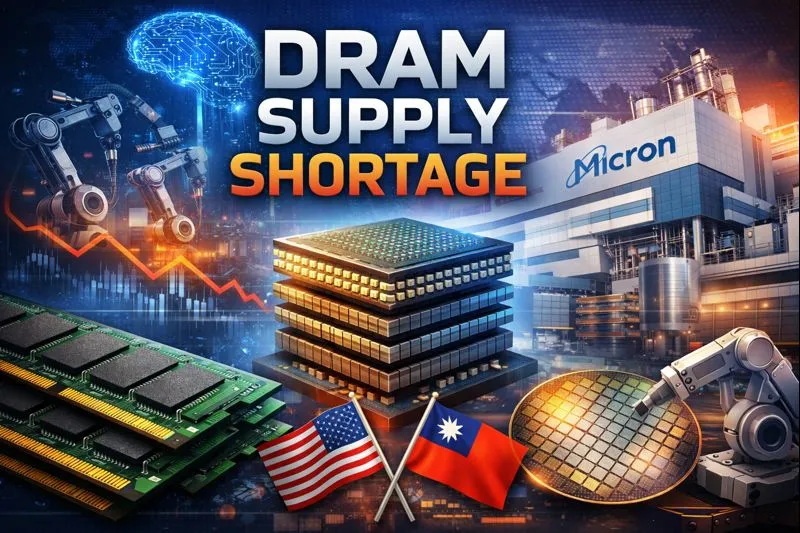
The global memory market is undergoing a structural transition, and DRAM supply shortage is becoming increasingly critical. Shares of Powerchip Semiconductor Manufacturing Corporation (PSMC) surged nearly 10% on January 19 following reports that Micron Technology plans to acquire one of PSMC’s wafer fabs in Taiwan (Reuters). Beyond market reaction, this move highlights how AI-driven demand is reshaping DRAM supply, advanced packaging strategies, and long-term capacity planning.
What Micron Is Acquiring and Why It Matters for DRAM Supply
On January 17, Micron confirmed it had signed a memorandum of understanding to acquire PSMC’s P5 wafer fab in Tongluo, Miaoli County, Taiwan, for USD 1.8 billion in cash (Micron Investors, GlobeNewswire). The deal covers fab buildings and facilities, excluding production equipment.
While it may appear as a simple real estate-style acquisition, it is a strategic move to accelerate DRAM supply expansion. The acquisition adds approximately 300,000 square feet of cleanroom space, a critical constraint in DRAM manufacturing. Given that constructing new fabs often takes several years, taking over an existing facility allows Micron to scale DRAM wafer production faster. The P5 fab is expected to meaningfully contribute to global DRAM output starting in the second half of 2027, helping to mitigate ongoing DRAM supply shortages (TrendForce).
Long-Term Foundry Cooperation Strengthens the DRAM Ecosystem
PSMC emphasizes that the deal goes beyond asset divestment. Micron and PSMC plan a long-term foundry partnership focusing on advanced DRAM packaging wafer manufacturing. Under this cooperation, Micron will support PSMC in enhancing specialty DRAM process technologies, including ongoing optimization at PSMC’s Hsinchu P3 fab. This positions PSMC as a strategic partner within Micron’s advanced DRAM supply ecosystem, not merely a seller.
For PSMC, the acquisition improves financial flexibility while accelerating its transition toward higher value-added memory and AI-focused manufacturing, aligning with broader DRAM supply growth strategies.
AI Demand Driving Advanced DRAM Packaging and 3D Integration
AI adoption is a key driver behind rising DRAM demand. Unlike traditional consumer electronics, AI servers and accelerators require higher bandwidth, lower power consumption, and advanced packaging architectures (The Verge).
PSMC plans to focus on AI-oriented technologies such as 3D AI DRAM, Wafer-on-Wafer (WoW), interposers, integrated passive devices (IPD), PMICs, and power devices including GaN and MOSFETs. Over time, non-AI DRAM production will gradually decrease to optimize profitability. This trend mirrors the broader industry shift toward HBM, 3D stacking, and heterogeneous integration (Business Standard).
Tight DRAM Supply Expected Beyond 2026
Micron CEO Sanjay Mehrotra previously stated that tight conditions in the memory market are likely to continue beyond 2026. This explains why Micron is securing expandable production capacity now rather than waiting for the next cyclical downturn (TrendForce).
Micron has operated in Taiwan for over 30 years and remains the island’s largest foreign direct investor. Its Taichung facilities already serve as major hubs for DRAM and HBM products. Once the P5 fab acquisition is completed, Micron will further strengthen regional manufacturing resilience and global DRAM supply.
The acquisition is subject to regulatory approval and is expected to close in Q2 2026.
Implications for Electronic Components Sourcing Amid DRAM Supply Shortage
This transaction sends two clear supply chain signals:
- DRAM capacity expansion will increasingly rely on acquisitions, partnerships, and upgrades to existing fabs rather than greenfield construction, favoring suppliers with flexible sourcing networks.
- AI-driven applications are reshaping DRAM product mixes, with lead times, availability, and qualification requirements varying by application and packaging type.
Working with experienced electronic components suppliers is essential. 7setronic supports customers with sourcing, allocation management, and risk mitigation for DRAM, memory ICs, and a broad range of electronic components, helping procurement teams navigate volatile DRAM supply conditions with confidence.
FAQ
1. Why is Micron acquiring a fab instead of building a new one?
Building a new wafer fab typically takes several years. Acquiring an existing facility allows Micron to expand DRAM capacity faster while AI-driven demand continues to intensify DRAM supply shortages.
2. How does AI impact DRAM supply availability?
AI servers and accelerators require advanced memory such as HBM and 3D-stacked DRAM, increasing pressure on DRAM manufacturing capacity and advanced packaging, often leading to longer lead times.
3. How can buyers manage DRAM sourcing risks in a tight market?
Buyers can mitigate risk by partnering with suppliers like 7setronic, which provide multi-channel sourcing, market intelligence, allocation planning, and long-term supply strategies to navigate DRAM supply shortage effectively.
For more information and to review our available inventory, please contact our team for detailed pricing, current stock levels, and any additional technical support you may need.
You can find more component guides and application notes in our Component Technical Guides section: