
Introduction
For small factories, understanding SMD vs Through-Hole Components is essential for efficient production, cost optimization, and product reliability. Choosing the right component type can determine assembly speed, mechanical stability, and overall manufacturing quality.
This guide explores the differences between SMD vs Through-Hole Components, key technical considerations, and practical advice for small factories.
What Are SMD and Through-Hole Components?
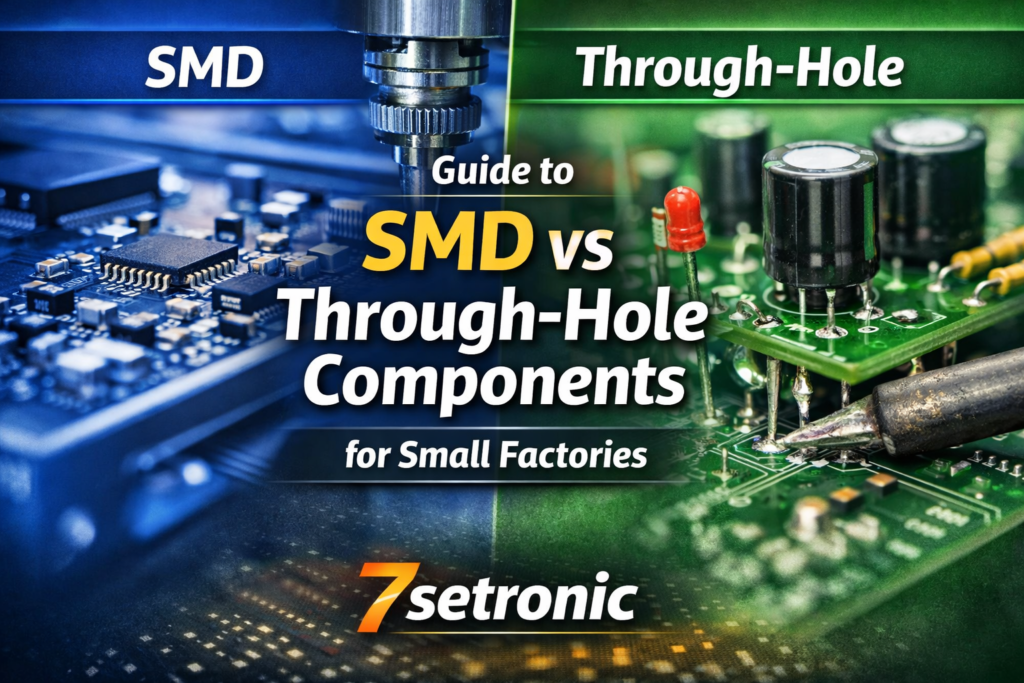
- SMD (Surface-Mount Device): Components mounted directly onto the PCB surface, suitable for high-density designs and automated assembly.
- Through-Hole Components: Components with leads inserted into drilled holes on the PCB, providing strong mechanical connections for high-power or industrial applications.
Understanding SMD vs Through-Hole Components helps factories decide which technology best fits their production setup.
Key Differences: SMD vs Through-Hole
| Feature | SMD Components | Through-Hole Components |
|---|---|---|
| Mounting Method | Soldered directly onto PCB surface | Leads pass through PCB holes and soldered on the opposite side |
| Component Size | Smaller, compact | Larger, bulkier |
| Assembly | Primarily automated using pick-and-place machines | Often manual or wave soldering |
| Mechanical Strength | Moderate; suitable for low-stress applications | High; ideal for connectors, heavy components, or high-vibration environments |
| Production Speed | Faster with automation | Slower due to manual handling |
| Cost | Lower cost per unit in high-volume production | Higher cost due to manual labor and larger footprint |
| Repair & Rework | More challenging to repair | Easier to replace and rework |
| Applications | Smartphones, wearables, dense PCB designs | Power supplies, industrial equipment, large connectors |
| Stock Availability | Wide variety of SMD components available from multiple suppliers | Some modern parts may only be through-hole |
| Suitability for Small Factories | Efficient for semi-automated or outsourced PCB assembly | Suitable for low-volume, manual assembly or prototype production |
This table clearly highlights the practical differences between SMD vs Through-Hole Components for small factories.
Considerations for Small Factories
- Production Volume:
- SMD is cost-effective for medium to large volumes due to automation.
- Through-hole remains practical for low-volume or custom products.
- Equipment & Skills:
- Automated pick-and-place machines are needed for SMD components.
- Manual soldering stations are sufficient for through-hole components, making it accessible to small workshops.
- Component Availability:
- SMD components like resistors, capacitors, and ICs are widely stocked.
- Some high-power or legacy parts may only be available in through-hole packages.
- Reliability & Environmental Factors:
- Through-hole components provide stronger mechanical connections for high-vibration environments.
- SMD components are ideal for compact, low-power consumer electronics.
Choosing between SMD vs Through-Hole Components depends on balancing production efficiency, assembly capabilities, and mechanical requirements. SMD components allow for faster assembly and higher PCB density, which is particularly beneficial for factories aiming to produce compact devices or scale up production with semi-automated or fully automated equipment. On the other hand, through-hole components provide superior mechanical strength, making them ideal for connectors, switches, and components subject to mechanical stress or vibration.
Small factories must also consider repairability and rework: SMD components can be more challenging to replace, whereas through-hole parts are easier to handle manually. By carefully evaluating production volume, available equipment, and the specific operational demands of the final product, manufacturers can strategically combine SMD and through-hole technologies to optimize cost, efficiency, and long-term reliability.
Case Example
A small factory producing custom LED controllers needed both SMD vs Through-Hole Components. Using SMD resistors allowed compact PCB design and faster automated soldering. Meanwhile, through-hole connectors ensured mechanical robustness during repeated plug-in cycles. Partnering with 7setronic, they sourced both component types efficiently, avoiding stock delays and meeting production targets.
Conclusion
For small factories, understanding SMD vs Through-Hole Components is crucial to optimize cost, efficiency, and product reliability. Combining SMD and through-hole technologies can provide the best of both worlds—fast assembly, compact design, and strong mechanical connections.
7setronic offers a wide selection of both SMD vs Through-Hole Components, fast delivery, and support for small factories looking to scale production without compromising quality. Request a quote today to secure the components your factory needs.
FAQ
Q1: Are SMD components more expensive than through-hole?
A1: SMD is cheaper per unit in high-volume production, though assembly requires automated equipment.
Q2: Can small factories handle SMD assembly?
A2: Yes, semi-automatic pick-and-place machines or outsourcing make SMD feasible.
Q3: Which is better for heavy connectors or power components?
A3: Through-hole components are preferred for mechanical strength and high-power applications.
View more insight: