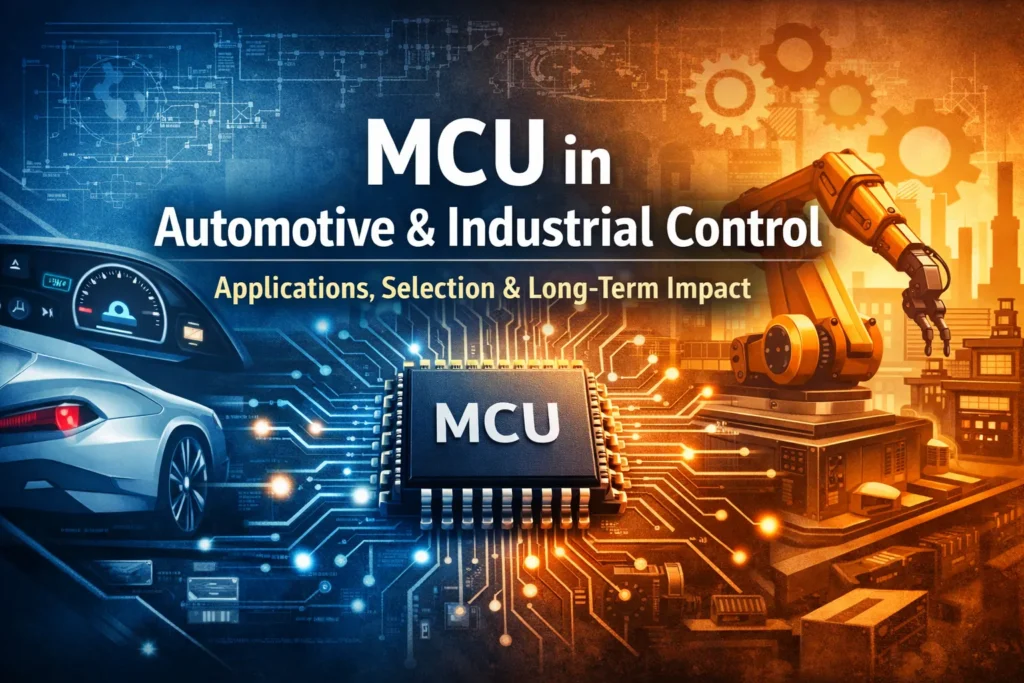
In automotive electronics and industrial control equipment, MCUs (Microcontroller Units) are used almost throughout the entire lifecycle of the equipment, from power-on to long-term operation. As the most fundamental control unit in the system, the MCU directly participates in sensor signal acquisition, logic judgment, actuator control, and communication management. Its stability and reliability often determine the overall system performance. Unlike general-purpose processors, MCUs are typically produced in long-term mass production and on fixed platforms. Once selected, they are used continuously for many years in the same system architecture, widely applied in body control modules, battery management systems, industrial automation equipment, sensor nodes, and other related systems.
Therefore, the application of MCUs not only affects system design and software architecture but also closely relates to subsequent supply continuity, maintenance costs, and project delivery risks. This article will analyze the basic definition of MCUs, system positioning, typical applications in automotive and industrial control systems, and common engineering considerations during selection and replacement, helping engineering teams to more clearly understand the long-term impact of MCUs in actual projects.
1. What is an MCU?
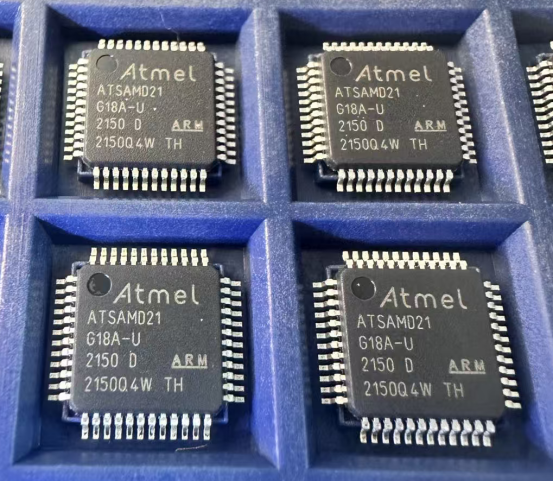
MCU is an abbreviation for Microcontroller Unit, formally known as a microcontroller, and is also often called a single-chip microcomputer. Within the realm of electronics, an MCU is a highly integrated control integrated circuit, essentially a “compact single-chip computer.” Its design logic integrates the processor core, various types of memory (flash memory, random access memory, etc.), and commonly used peripheral modules such as timers, serial communication interfaces, and analog-to-digital converters onto a single chip.
Unlike general-purpose computers like laptops and servers, which are designed for complex data processing and multitasking, MCUs are deeply optimized from hardware architecture to instruction sets for three main requirements: real-time response, low power consumption, and high cost-effectiveness. Their primary mission is not to perform complex calculations, but rather to focus on various deterministic control tasks in embedded systems, such as logic start/stop of industrial equipment, command response in smart homes, and status monitoring in automotive electronics. They are widely used control devices in embedded application environments.
2. What are the major MCU brands?
As of 2025, the global MCU market is mainly concentrated in the hands of a few international semiconductor manufacturers, resulting in a relatively high market concentration. Different manufacturers have different focuses in application areas such as automotive, industrial control, and the Internet of Things.
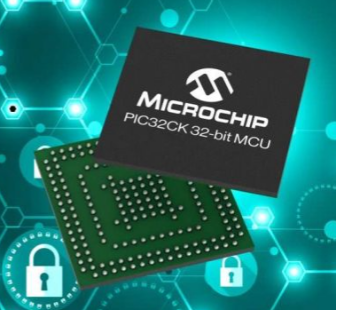
In terms of market size and application coverage, Infineon, Renesas, NXP, STMicroelectronics (ST), and Microchip are generally considered mainstream MCU suppliers, with their products widely used in automotive electronics, industrial equipment, and general-purpose embedded systems.
Besides these manufacturers, some brands have high usage frequency in specific applications. For example, TI is commonly used in low-power control systems, Espressif and Nordic are mostly used in wireless and IoT devices, Raspberry Pi is widely used in education and prototyping, and GigaDevice is frequently used in cost-sensitive projects using general-purpose 32-bit MCUs.
3. What is the basic role of an MCU in a system?
In most automotive and industrial-related equipment, MCUs do not undertake complex computational tasks but are responsible for deterministic control. They typically operate under fixed timing, performing functions such as state management, signal acquisition, logic judgment, and actuator driving. These tasks have high requirements for real-time response and system consistency; therefore, MCUs are often permanently tied to the system architecture.
In practical engineering, MCUs are more often seen as the “base” of a system than as replaceable computing units. Once the control logic, peripheral configuration, and interrupt mechanisms are determined, the stability of the system largely depends on the platform itself. This is why, in mass-produced equipment, even if newer models with higher performance emerge later, the original solution will continue to be used for many years.
Compared to high-performance processors, the MCU’s operating environment is closer to the hardware boundary layer, and its stable operation often directly affects the reliability of the entire system.
4. What control functions does the MCU handle in automotive electronic systems?
In automotive electronic architecture, MCUs are widely used in multiple subsystems, such as:
- Body control module
- Braking and steering control unit
- Battery management system
- Airbag and sensor nodes
These systems typically require long-term stable operation under complex operating conditions such as high and low temperature cycles, strong electromagnetic interference, and continuous mechanical vibration. In such applications, the MCU mainly undertakes low-level control functions, including sensor signal acquisition, status and logic judgment, and actuator driving, and maintains real-time data interaction with upper-level controllers or domain control units through communication buses such as CAN, LIN, or automotive Ethernet.
These applications require long-term stable operation under complex conditions such as high and low temperature cycling, strong electromagnetic interference, and continuous mechanical vibration. In such applications, the MCU primarily undertakes low-level control functions, including sensor signal acquisition, status and logic judgment, and actuator driving. It maintains real-time data interaction with upper-level controllers or domain control units via communication buses such as CAN, LIN, or automotive Ethernet.
5. What are the typical applications of MCUs in industrial control equipment?
In industrial automation and control-related equipment, the application of MCUs is more diversified. Common applications include:
- Industrial sensor data acquisition
- Actuator control
- Local human-machine interface management
- Communication protocol processing
Compared to automotive systems, industrial equipment faces significantly different operating conditions. Different applications vary greatly in terms of temperature, load, interference, and continuous operation requirements. However, they share common characteristics such as long system operating cycles and low frequency of on-site maintenance. Many industrial control systems, after deployment, often do not undergo hardware-level adjustments for many years, adapting to changes in processes or operating conditions only through parameter configuration or software logic updates.
In this application context, the long-term availability and supply continuity of MCUs are often evaluated above performance parameters. Some engineering teams explicitly focus on device lifecycle planning, production line stability, and subsequent capacity expansion support during the selection phase to reduce the risk of forced hardware modifications during system maintenance, upgrades, or capacity adjustments. This proactive consideration helps maintain system consistency and operational controllability in long-running industrial projects.
6. Why are MCU applications difficult to replace quickly?
From a system perspective, MCU replacement is far more than just a matter of matching parameters or pins. Even with similar package types and performance specifications, the actual replacement process can still trigger a series of chain adjustments:
- Re-verification of hardware electrical characteristics
- Adjustment of underlying software drivers and startup processes
- Communication protocol and timing adaptation
- Extended system-level testing cycle
In automotive and industrial applications, these adjustments often require collaborative efforts from hardware, software, testing, and quality control teams, while also being constrained by functional safety, compliance certifications, and predetermined project milestones. Therefore, when delivery dates or supply fluctuate, engineering teams typically prefer to buffer risks through adjustments to production schedules, optimized inventory strategies, or pre-locking in materials, rather than abruptly switching MCU platforms mid-project.
7. What should be considered during the MCU selection phase?
From practical application experience, MCU selection should not solely focus on performance indicators but should be comprehensively evaluated in conjunction with the specific usage environment and system constraints. For example:
- Are there long-term mass production and maintenance requirements?
- The degree of software and system dependence on the platform?
- The feasibility of subsequent design adjustments?
Some technical teams with long-term experience supporting automotive and industrial projects (such as 7SE’s experience in project collaboration) often focus on these application-level constraints earlier, rather than simply relying on device specifications. This experience often reduces the uncertainty caused by later adjustments in complex projects.
8. How does the application method of an MCU affect long-term supply and system stability?
From a practical application perspective, the way an MCU is used determines its high dependence on supply continuity. Unlike peripheral devices, they are usually deeply embedded in system logic, undertaking core control and status management functions. Once mass production begins, the hardware configuration, underlying software, and communication timings are often largely fixed. Therefore, changes in delivery dates or supply structures typically don’t manifest in the early stages of a project, but rather become apparent as the system nears delivery or during capacity expansion.
For this reason, in recent years, against the backdrop of increasing supply environment volatility, more and more engineering teams have begun to simultaneously evaluate non-performance factors during its selection phase. These factors include product lifecycle planning, manufacturing and packaging/testing distribution, and supply flexibility in different regions. These considerations do not stem from changes in functional requirements but rather from project management’s realistic response to long-term delivery risks.
Based on application experience, MCU selection is gradually shifting from a “parameter-oriented” to a “system-oriented” approach. In addition to performance metrics, engineering teams typically focus on the following: whether the system requires long-term mass production and maintenance, the degree of software architecture dependence on a specific platform, and the feasibility of design adjustments if necessary. These factors often determine the project’s flexibility in responding to supply changes.
In actual collaborations on automotive and industrial projects, technical teams with extensive experience in multi-platform support and delivery coordination (such as 7SE’s practical experience in related projects) typically recognize these application-level constraints earlier. This judgment, based on system operating cycles and delivery schedules, helps reduce the uncertainty caused by later adjustments in complex environments.
The value of MCUs in automotive electronics and industrial control systems lies not only in performance parameters or functional configurations, but also in their stable support role throughout the entire system lifecycle. From architecture design and software adaptation to mass production delivery and long-term maintenance, the MCU always exists as the underlying control core, and its selection decisions often have a continuous impact on project schedules, maintenance costs, and system consistency. As application complexity and supply environment uncertainty continue to increase, engineering teams’ understanding of MCUs is gradually returning to “the application itself.” Meeting functional requirements while considering long-term controllability and system stability has become a consensus in an increasing number of practical projects.
FAQ
Q1: What is the role of an MCU in automotive and industrial control systems?
A1: An MCU acts as the core control unit responsible for real-time tasks such as sensor data acquisition, logic processing, actuator control, and communication management. Its stability directly affects overall system reliability.
Q2: Why are MCUs difficult to replace once a system enters mass production?
A2: Because MCU replacement often requires hardware re-verification, software driver modification, protocol timing adjustments, and extended system-level testing, especially in automotive and industrial applications with strict safety and reliability requirements.
Q3: What factors should be considered when selecting an MCU for long-term projects?
A3: Beyond performance specifications, engineers should consider supply continuity, product lifecycle support, software platform dependence, and the feasibility of future design adjustments to reduce long-term project risks.
Q4: How to verify the quality of MAX3485EESA+T?
A4: 7SEtronic follows complete SOP-based quality inspection, including label verification, visual inspection, and X‑RAY testing.
You can find more component guides and application notes in our Component Technical Guides section: