
Overview
The MIC29302WU is a high-current low-dropout (LDO) linear voltage regulator designed for high-load, low-voltage power regulation. It is widely used in industrial control systems, networking equipment, and embedded processor rails, where fast transient response, low dropout voltage, and high output accuracy are required.
As part of Microchip’s MIC29xxx regulator family, the MIC29302WU supports demanding power rails while maintaining excellent thermal and protection performance. The MIC29302WU-TR variant offers the same electrical characteristics in tape-and-reel packaging for automated assembly.
Core Parameters
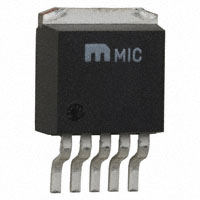
| Parameter | Specification |
|---|---|
| Output Current | Up to 3 A |
| Dropout Voltage | Typically 370 mV at 3 A |
| Output Voltage Accuracy | ±1% |
| Input Voltage Range | Up to 26 V |
| Quiescent Current | Low IQ for high-current LDO |
| Protection Features | Thermal shutdown, current limiting |
| Package | TO-263 / D²PAK (WU) |
These parameters make the device suitable for high-current post-regulation, especially where low dropout and tight voltage tolerance are critical.
Features
- High output current capability up to 3 A
- Low dropout voltage for improved efficiency
- Fast transient response for dynamic loads
- Excellent output accuracy over temperature
- Internal current limiting and thermal protection
- Stable with low-ESR output capacitors
- Available as MIC29302WU-TR for high-volume production
Typical Application Scenarios
- Post-regulation for switching power supplies
- Embedded CPU, FPGA, and DSP power rails
- Industrial automation and control boards
- Networking and telecom equipment
- Automotive and high-reliability systems (non-safety-critical)
In MIC29302WU high-current LDO designs, the EEE-FK1E330P is commonly used as a low-ESR output electrolytic capacitor. It helps improve transient response and output stability, making it a frequent choice in industrial and embedded power supply applications.
Performance Comparison
Compared with standard linear regulators, the MIC29302WU offers significantly higher output current and lower dropout, making it more suitable for modern low-voltage, high-load applications. Versus switching regulators, it provides lower output noise and simpler design, ideal for sensitive analog or digital loads requiring clean power.
Conclusion
The MIC29302WU delivers a robust balance of high current capability, low dropout voltage, and reliable protection features, making it an excellent choice for demanding linear regulation tasks. With the MIC29302WU-TR option supporting automated manufacturing, it is well suited for both prototype and production designs.
Manufacturer Profile

Microchip Technology is a leading global supplier of microcontrollers, analog ICs, and power management solutions. Its linear regulator portfolio, including the MIC29xxx series, is widely adopted in industrial, automotive, and embedded applications for proven reliability and long-term availability.
FAQ
Q1: What makes MIC29302WU suitable for high-current applications?
It supports up to 3 A output current with low dropout voltage and fast transient response, ensuring stable operation under heavy and dynamic loads.
Q2: Can MIC29302WU be used after a switching regulator?
Yes. It is commonly used as a post-regulator to reduce ripple and noise while improving voltage accuracy.
Q3: What are the key electrical and functional characteristics of the MIC29302WU?
The MIC29302WU is a high-current LDO regulator featuring low dropout voltage, fast transient response, and built-in protection functions such as current limiting and thermal shutdown, making it suitable for demanding power regulation applications.
Q4: How can the quality of MIC29302WU be verified?
7SEtronic follows a complete quality inspection SOP, including label verification, visual inspection, dimensional checks, and X-ray analysis where required, ensuring authenticity and reliability.
For more information and to review our available inventory, please contact our team for detailed pricing, current stock levels, and any additional technical support you may need.
You can find more component guides and application notes in our Component Technical Guides section: