
Overview
The NCP1608BDR2G is a Power Factor Correction (PFC) controller IC designed for offline AC-DC converter front ends and power management systems. It is widely used in AC adapters, electronic ballasts, and LED driver supplies, where near-unity power factor, low startup current, and robust protection are required.
Operating in Critical Conduction Mode (CrM), this controller simplifies PFC design while minimizing harmonic distortion and improving overall energy efficiency.
Core Parameters
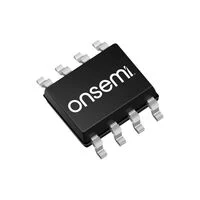
| Parameter | Specification |
|---|---|
| Device Type | PFC Controller IC |
| Mode of Operation | Critical Conduction Mode (CrM) |
| Supply Voltage Range | ~10.2 V to 20 V |
| Startup Current | ≤ 35 µA |
| Operating Temp Range | −40°C to +125°C |
| Package | SOIC-8 |
| Typical Supply Current | ~2.1 mA |
| Gate Drive Output | Source 500 mA / Sink 800 mA |
These parameters make the device suitable for power factor correction front ends, especially where low startup current and wide supply voltage range are critical.
Features
- Critical Conduction Mode (CrM) operation for improved power factor
- Transconductance error amplifier for precise control
- Low startup current consumption (< 35 µA)
- Built-in undervoltage lockout and overvoltage protection
- Integrated high-current gate driver
- Surface Mount SOIC-8 package for compact designs
- Pb-Free, RoHS3 compliant
Typical Application Scenarios
- AC-DC adapters and power bricks
- Electronic ballasts and solid state lighting
- LED driver power supplies
- Consumer electronics power stages
- Industrial power conversion systems requiring PFC
The NCP1607BDR2G is closely related to the NCP1608BDR2G and is often evaluated in similar critical-conduction-mode PFC designs. Both controllers target offline AC-DC front ends, offering low startup current and high power factor, making them suitable for adapters, LED drivers, and consumer power supplies.
Performance Comparison
| Feature | NCP1608BDR2G | Linear PFC Controllers | Advanced Digital PFC |
|---|---|---|---|
| Power Factor | Near unity | Moderate | Excellent |
| Startup Current | Very Low | Medium | Low |
| Protection | Built-in | Limited | Extensive |
| External Components | Few | More | More |
| Efficiency | High | Low | Very High |
Compared with linear PFC controllers, the NCP1608BDR2G achieves higher efficiency and better power factor with fewer external parts. Against advanced digital PFC solutions, it provides simplicity and cost efficiency for moderate-power designs.
Conclusion
The NCP1608BDR2G is an effective PFC controller IC optimized for offline power supplies needing efficient power factor correction and low startup current. Its integrated protection features and CrM control simplify design and improve overall power quality in AC-DC front ends.
Manufacturer Profile

onsemi (ON Semiconductor) is a global semiconductor leader providing energy-efficient power and signal management solutions for automotive, industrial, and consumer applications. onsemi’s PFC controllers are widely used in AC-DC conversion systems for improved energy efficiency and compliance with global power quality standards.
FAQ
Q1: What type of controller is the NCP1608BDR2G?
It is a Power Factor Correction (PFC) controller designed to improve power factor and reduce harmonics in AC-DC converters.
Q2: What operation mode does it use?
The NCP1608BDR2G operates in Critical Conduction Mode (CrM) to achieve near-unity power factor and efficient performance.
Q3: What is the typical supply current consumption?
Under normal operation, the controller typically draws around 2.1 mA, with very low startup current consumption (<35 µA).
Q4: How can the quality of the NCP1608BDR2G be verified?
7SEtronic has a complete, standardized quality inspection SOP, including label verification, visual appearance checks, and X-RAY analysis, to ensure product authenticity and performance.
For more information and to review our available inventory, please contact our team for detailed pricing, current stock levels, and any additional technical support you may need.
You can find more component guides and application notes in our Component Technical Guides section: