
In overseas factory operations, cargo transportation is not only a logistics execution issue but also a crucial aspect of supply chain design. How to integrate fragmented supplier cargo transportation, optimize transportation schedules, reduce costs, and improve inventory controllability are major challenges faced by many companies in cross-border procurement and overseas production. This article will systematically analyze overseas factory cargo integration methods from the perspectives of Less-than-Container Load (LCL), supplier integration models, transportation management practices, and the characteristics of the electronics manufacturing industry, providing companies with actionable solutions.
Why Overseas Factories Need to Establish Cargo Consolidation Mechanisms
For overseas factories operating outside the countries where suppliers are located, integrating cross-border cargo transportation resources is no longer just a logistics issue at the execution level but a key aspect of supply chain structure design. Transportation arrangements directly affect working capital, inventory turnover efficiency, and the stability of production scheduling. When procurement sources are diversified and the number of suppliers increases, while cargo transportation remains independent, the overall transportation costs and management complexity of overseas factories often rise rapidly, increasing the difficulty of cargo integration.
Without a systematic integration mechanism, overseas factories typically face the following problems:
- Small-batch, high-frequency shipments drive up unit transportation costs.
- Repeated customs declarations and clearance processes consume time and manpower.
- Increased volume of documents, tracking numbers, and reconciliation records increases the difficulty of integration and management.
- Scattered arrivals disrupt warehousing rhythms and affect the stable execution of production plans.
This decentralized transportation model may be sustainable when order sizes are small, but as overseas factories increase production capacity and order structures become more complex, integrating cargo transportation becomes a crucial management challenge. Transportation is no longer just a cost issue but a direct factor affecting the stability and responsiveness of the factory’s supply chain.
By establishing a standardized cargo consolidation mechanism, overseas factories can integrate previously scattered cargo transportation activities into a planned shipping system, making transportation rhythms better match production needs. Integrated transportation arrangements help clarify cost structures, centralize customs clearance processes, stabilize inventory rhythms, and make cargo flow more controllable. Compared to passively dealing with multiple arrivals, proactively considering how to integrate the cargo transportation of overseas factories is more in line with the management requirements of large-scale operations.
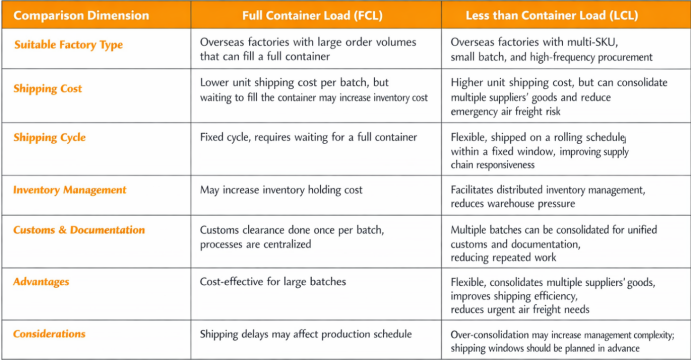
When should overseas factories consider Less-than-Container Load (LCL) shipping?
Under specific procurement structures and transportation conditions, LCL shipping, compared to independent shipments, helps overseas factories consolidate scattered cargo transportation resources and optimize the overall transportation structure. For companies considering how to consolidate cargo transportation from overseas factories, the following situations are particularly worth evaluating for establishing an LCL mechanism:
- Procurement from multiple suppliers in the same country or region
When materials originate from the same country or industrial cluster, arranging cargo transportation in a dispersed manner often leads to wasted transportation resources and increases the difficulty of consolidation. Through LCL consolidation, goods from different suppliers can be concentrated at the same shipping node, optimizing transportation routes, improving loading efficiency, and reducing repeated handling and management costs. This approach helps overseas factories more systematically integrate cargo transportation processes.
- High order frequency, but single order quantity insufficient to support Full Container Load (FCL) shipping
For medium-sized overseas factories, the procurement rhythm may be relatively stable, but the quantity of a single order is insufficient to fill a full container. In this case, how to arrange cargo transportation becomes the main issue. Insisting on full container load (FCL) shipments may require waiting for consolidation; completely fragmented shipments result in higher unit transportation costs. Less-than-container-load (LCL) shipments strike a balance between transportation costs and delivery time, making them more suitable for factories requiring flexible cargo consolidation.
- The increasing proportion of air freight makes logistics costs difficult to control.
Frequent small-batch emergency replenishment often indicates a lack of overall integrated planning for cargo transportation. When overseas factories find air freight becoming the norm, they need to reassess how to integrate cargo transportation rhythms. By setting relatively fixed LCL cycles, the occurrence of ad-hoc, high-cost transportation can be reduced, making the overall transportation structure more stable.
- Unstable warehousing times affect storage and production scheduling.
Scattered arrivals fragment warehousing plans, increasing the complexity of receiving, quality inspection, and inventory management. When material arrival times are unpredictable, overseas factories need to consider how to establish a clearer warehousing rhythm through integrated cargo transportation. LCL mechanisms can create relatively fixed transportation windows, improving supply chain predictability.
Common Cargo Consolidation and Transportation Management Models for Overseas Manufacturing
When considering how to consolidate cargo transportation for overseas factories, companies of different sizes and with varying resources can choose different levels of consolidation models. To optimize transportation costs and improve supply chain controllability, overseas factories typically employ different levels of cargo consolidation. Based on resource conditions and order characteristics, the following models can be selected:
Supplier-Level Consolidation
In this model, suppliers are responsible for delivering goods to designated consolidation warehouses or collection points. The warehouses then handle unified sorting, consolidation, and packing before unified export.
- Applicable Situations: Procurement is concentrated in the same region or industrial cluster, such as electronic material suppliers in Shenzhen, Suzhou, or Penang. Components from multiple suppliers need to be delivered in the same batch so that the factory can produce according to plan.
- Practical Recommendations: Clearly define delivery deadlines and packaging standards for each supplier to avoid duplicate warehouse operations or material backlogs. Establish traceable records for warehousing and logistics to ensure that consolidated shipment information is transparent and verifiable.
Third-Party Consolidation Centers
Utilizing professional logistics or procurement partners, goods from different suppliers are consolidated at third-party consolidation centers, where quality inspection, labeling, and documentation are completed before final export.
- Suitable Situations: Factories with limited internal warehousing or logistics resources cannot handle large-volume consolidation tasks. Exported goods require unified quality inspection to ensure each batch of materials meets factory standards. Complex export compliance requirements necessitate a professional team to assist with document processing and customs clearance.
- Practical Recommendations: Choose experienced consolidation service providers that cover major export requirements and local regulations. Integrate consolidation centers into supply chain visibility management to make cargo flow, status, and arrival times predictable.
- Rolling LCL (Scheduled Delivery) Factories set fixed delivery cycles, such as weekly or bi-weekly, eliminating the need to wait for full containers before shipment. All orders arriving before the deadline are shipped together.
- Advantages: Stable shipping rhythm, reducing cost fluctuations caused by ad-hoc LCL or air freight. Improved supply chain predictability, facilitating warehousing and production planning management.
- Practical Recommendations: Establish deadlines for each shipping cycle and notify suppliers in advance to ensure materials arrive on schedule. Coordinate with a warehouse management and transportation management system (TMS) to track the status of each shipment in real time and optimize consolidation efficiency.
Operational Focus of Cargo Consolidation in Overseas Factories
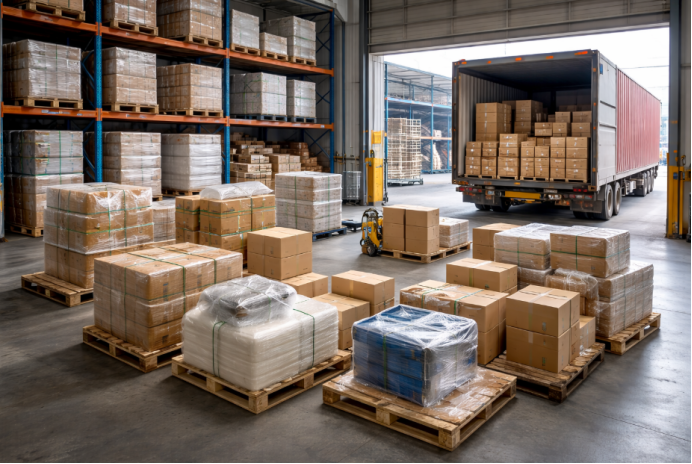
Implementing cargo consolidation and optimizing transportation structures in overseas factories is not merely about centralizing goods; it’s about enhancing supply chain collaboration capabilities. Cargo consolidation in overseas factories requires close cooperation between procurement, logistics teams, and suppliers to ensure an efficient and controllable transportation process. The following are key factors to consider when integrating transportation arrangements:
- Inventory Transparency: Ensuring traceable inventory information helps factories adjust production plans promptly, avoiding production interruptions or inventory backlogs due to transportation delays.
- Delivery Time Coordination: Unifying delivery windows ensures smooth cargo consolidation and improves integrated transportation efficiency.
- Packaging Standardization: Standardizing packaging sizes and materials increases loading rates, reduces transportation damage, and facilitates rapid sorting.
- Customs Clearance and Document Management: Maintaining consistent and complete export documents, customs declarations, and labels ensures smooth customs clearance and avoids transportation delays or additional costs.
Impact and Balance of Cost Structure
Cost balance is a primary consideration when discussing how to integrate overseas factory cargo transportation to optimize cost structure. The goal of integrating cargo transportation is not just to reduce single-trip freight costs, but to optimize the overall logistics and operating costs of overseas factories.
When factories integrate cargo transportation in a planned manner, cost improvements can typically be achieved at multiple levels:
Unit Transportation Cost: Centralizing the handling of scattered shipments increases loading rates, effectively distributing transportation costs and making the average transportation cost per shipment more controllable.
- Customs Declaration and Clearance Costs: Reducing the number of export shipments means fewer customs declarations. For overseas factories, this directly impacts long-term administrative and clearance expense structures.
- Internal Administrative Processing Time: With fewer shipments, related documentation, tracking records, and reconciliation work will be more centralized, helping to reduce internal communication and management costs.
- Emergency Air Freight Expenses: When the consolidation mechanism is stable and the transportation rhythm is clearer, the need for temporary air freight replenishment will significantly decrease, thus avoiding high emergency logistics costs.
Furthermore, when planning how to consolidate the transportation of goods from overseas factories, it is necessary to be wary of the side effects of excessive consolidation. Delaying shipments to increase the consolidation ratio may increase inventory holding costs or affect the overall transportation schedule due to waiting for individual suppliers to deliver. Once transportation delays affect the production rhythm, the cascading costs often exceed the savings in freight costs.
The focus of consolidating the shipping plan is not on “consolidating the most,” but on finding a reasonable range between transportation efficiency, inventory levels, and stable delivery. A truly mature integration approach maintains a rhythmic flow of goods, enabling overseas factories to control costs while ensuring stable production and supply chain operations.
How Overseas Electronic Factories Can Gain Structural Advantages Through Integrated Freight Transportation
In the electronics manufacturing industry, how overseas factories integrate freight transportation directly impacts inventory risk and delivery stability. The electronics industry presents distinct unique challenges when discussing how to integrate freight transportation for overseas factories. Electronic component procurement typically involves numerous models, small batches, and dispersed delivery dates, making freight transportation management more complex than for general industrial goods.
For overseas electronics factories, systematically integrating freight transportation not only improves logistics costs but also brings additional supply chain advantages:
Reduced Handling Risks of Sensitive Components: Many electronic components are highly sensitive to static electricity, vibration, and temperature changes. Frequent transfers at multiple transportation nodes significantly increase risk. Integrated shipping reduces intermediate handling steps, concentrating freight routes and reducing the probability of damage.
More Effective Control of Humidity and Storage Conditions: Some electronic materials have strict requirements for humidity levels (MSL). In integrated shipment management, centralized management and standardized packaging help maintain standards of dryness, moisture protection, and vacuum sealing, reducing quality risks caused by environmental factors.
- Centralized Quality Confirmation Before Export: Unified inspection before integrated transportation allows for batch confirmation and visual checks before goods leave the country, reducing the risk of quality disputes and returns upon arrival at overseas factories.
- Improved Batch Traceability: Electronic factories typically require strict batch management. Integrating shipment transportation and standardizing document management makes batch numbers, production dates, and supplier information clearer, facilitating subsequent traceability and inventory management.
- Electronic Bill of Materials (BOM) Structure: Electronic bills of materials (BOMs) often have a wide variety of items with limited quantities, making it difficult to ship single models in large quantities. In this context, integrating shipments from overseas factories becomes more than just a logistics arrangement issue; it becomes part of supply chain management capabilities.
When the integration mechanism is stable, overseas factories can maintain a variety of materials while ensuring more organized transportation and better inventory control. This supply chain advantage is significant for electronics manufacturing companies. Through rational planning and systematic integration, overseas factories can not only reduce transportation costs but also improve supply chain controllability and production stability. For electronics manufacturing companies, efficient cargo transportation management helps them maintain stable material supply and production rhythm in a multi-supplier and cross-border procurement environment.
In this process, choosing experienced electronic component partners can help overseas factories cope more smoothly with supply fluctuations and transportation arrangements. This is also a key objective that 7SEtronic has always focused on when serving its clients, helping factories maintain production continuity from the source and achieve greater predictability in supply chain management.
Frequently Asked Questions (FAQ)
Q1: How can overseas factories reduce cross-border transportation costs?
A1: By establishing a multi-supplier cargo consolidation mechanism and combining LCL (Less than Container Load) and regular shipping models, a balance can be achieved between transportation efficiency and inventory levels.
Q2: Which overseas factories are suitable for LCL?
A2: Suitable for multi-SKU, small-batch, high-frequency procurement structures.
Q3: Will consolidated transportation increase inventory costs?
A3: If the shipping cycle is designed reasonably, a balance can be achieved between inventory and transportation costs.
Q4: Are electronic components suitable for LCL (Less than Container Load) shipping?
A4: Provided that packaging, moisture protection, and batch management standards are followed, LCL shipping can improve transportation efficiency and reduce overall logistics costs.
View more insight:
- How to handle exchange rate fluctuations in procurement cost management
- How to check component authenticity online
- Which Chips Were Hottest in 2025? (with a Summary of Popular Part Number for the Year)
- How Supply Chain Changes Affect Small Factories
- How to Optimize BOM to Reduce Cost in Electronics Manufacturing