Overview
The TXB0108PWR is an 8-bit bidirectional voltage-level translator designed for mixed-voltage digital interface communication. It is widely used in MCU interfacing, mixed-voltage logic systems, and communication buses, where automatic direction sensing and wide voltage range translation are required.
This translator enables seamless bidirectional logic translation without the need for a direction control pin, making it ideal for modern low-power digital systems.
Core Parameters
| Parameter | Specification |
|---|---|
| Channel Count | 8-bit bidirectional |
| Voltage Range A Port (VCCA) | 1.2 V to 3.6 V |
| Voltage Range B Port (VCCB) | 1.65 V to 5.5 V |
| Direction Control | Automatic (no DIR pin) |
| Maximum Data Rate | ~100 Mbps push-pull (typical) |
| ESD Protection | ±15 kV Human-Body Model |
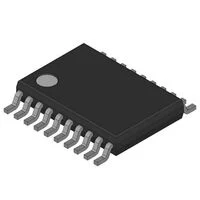
| Package | 20-pin TSSOP |
| Operating Temperature | –40°C to +85°C |
These parameters make the device suitable for mixed-voltage logic interfacing, especially where wide voltage range translation and high-speed operation are critical.
Features
- Automatic bidirectional direction sensing – no direction control pin required.
- Wide voltage translation range from 1.2 V to 5.5 V.
- High-speed operation for push-pull interfaces.
- Low power consumption (low ICC).
- Robust ESD protection, including ±15 kV on B port.
- Partial power-down support with Ioff circuitry.
- High-impedance outputs when OE is low or during power-down.
Typical Application Scenarios
- Interfacing MCUs and sensors operating at different logic levels.
- UART, SPI, and GPIO bidirectional communication.
- Mixed-voltage logic integration in embedded systems.
- Portable electronics requiring power-efficient logic translation.
In applications that involve open-drain buses such as I²C or SMBus, designers often choose LSF0108PWR instead of TXB0108PWR, as LSF0108PWR is optimized for open-drain signaling, while TXB0108PWR is better suited for push-pull, high-speed digital interfaces.
Performance Comparison
| Feature | TXB0108PWR | Simple Unidirectional Shifter | Traditional Non-Auto Translator |
|---|---|---|---|
| Direction Handling | Automatic bidirectional | Unidirectional only | Needs direction pin |
| Voltage Range | 1.2–5.5 V | Limited | Limited |
| Speed | Up to ~100 Mbps | Medium | Medium |
| ESD Protection | High (±15 kV) | Lower | Variable |
| Power | Low | Variable | Variable |
Compared with unidirectional or direction-pin translators, TXB0108PWR provides simplified design, wider voltage support, and faster operation for bidirectional digital logic systems.
Conclusion
The TXB0108PWR is a versatile and efficient bidirectional voltage-level translator for modern embedded and mixed-voltage digital designs. Its automatic direction sensing, wide input/output voltage compatibility, and robust ESD protection make it a strong choice for interfacing logic between different systems.
Manufacturer Profile

Texas Instruments (TI) is a global leader in semiconductors, analog, and embedded processing technologies. TI’s voltage translators and logic-level interfaces are well-established for performance, reliability, and broad application support in industrial and consumer markets.
FAQ
Q1: What is the main purpose of the TXB0108PWR?
It provides automatic bidirectional logic voltage translation between different voltage domains (1.2 V to 5.5 V) in digital systems.
Q2: What communication buses can use the TXB0108PWR?
It can be used with GPIO, SPI, UART, and other bidirectional logic signals.
Q3: What are the key advantages of using TXB0108PWR in mixed-voltage designs?
TXB0108PWR supports a broad voltage range, requires no direction pin due to automatic sensing, and offers high-speed performance with strong ESD protection.
Q4: How can the quality of TXB0108PWR be verified?
7SEtronic follows a complete quality inspection SOP, including label checks, visual inspection, and X-ray testing, to ensure product authenticity and performance reliability.
For more information and to review our available inventory, please contact our team for detailed pricing, current stock levels, and any additional technical support you may need.
You can find more component guides and application notes in our Component Technical Guides section: