
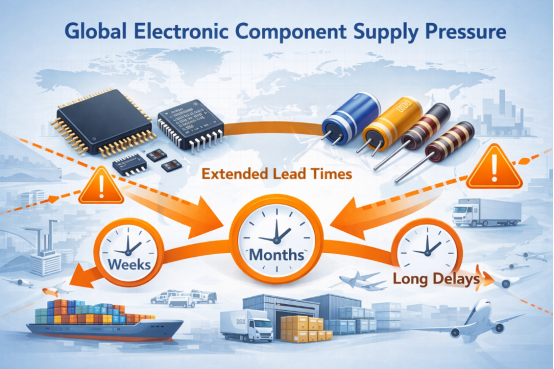
In recent years, global component shortages have significantly impacted the electronics manufacturing industry. Lead times for many commonly used chips, capacitors, resistors, and microcontrollers can extend from weeks to months in a short period. This supply pressure stems not only from capacity adjustments and raw material fluctuations but is also influenced by increased end-user demand, logistical delays, and changes in the global trade environment, making market inventory fluctuations frequent and unpredictable. For companies reliant on stable materials, even slight delivery delays can significantly impact production plans and shipping schedules.
In this context, relying solely on fixed suppliers or short-term procurement strategies often fails to guarantee production continuity. To effectively address global component shortages, procurement teams need to plan material needs in advance, establish multiple supply channels, and continuously monitor inventory changes and price fluctuations. Furthermore, evaluating alternative models, maintaining appropriate safety stock, and maintaining ongoing communication with engineering teams all contribute to improving procurement flexibility and production resilience during periods of market instability. This article will analyze these strategies in depth to help companies optimize procurement arrangements, reduce the risk of component shortages, and maintain operational stability in a tight supply environment.
1. Plan Procurement Needs in Advance:
Planning procurement needs in advance helps reduce supply uncertainty during global component shortages. For electronics manufacturers reliant on stable supply chains, if procurement relies heavily on short-term inventory or ad-hoc orders, production plans are more susceptible to disruption once market supply tightens.
During periods of relatively stable supply, the lead time for many electronic components is typically only a few weeks. When market demand increases or capacity is limited, lead times often lengthen, with some models potentially requiring months. Procurement in advance, combined with production planning and clearer forecasts of future demand, can reduce production risks caused by lead time changes and provide companies with more preparation time during global component shortages.
For components used frequently in production or those difficult to replace in the short term, some companies lock in a certain amount of inventory while supply remains stable. Although this ties up some inventory capital, it provides a buffer for production during periods of supply chain fluctuations or tightening market inventory, thus reducing the impact of sudden material shortages on production schedules.
2. Avoid Relying on a Single Procurement Channel:
During periods of relatively stable supply, many companies are accustomed to long-term partnerships with fixed suppliers, a common practice in daily procurement. However, during periods of global component shortages, if procurement relies primarily on a single channel, a decrease in that supplier’s inventory or a significant extension of delivery time can restrict procurement progress, impacting production schedules.
To mitigate this risk, some procurement teams proactively establish broader supply sources, such as collaborating with different types of suppliers, including:
- Authorized distributors
- Independent electronic component distributors
- Regional electronic component trading markets
With more diversified procurement channels, even if one channel experiences inventory shortages, companies can still find suitable sources through others. This approach increases procurement flexibility during periods of market tightness and helps locate available inventory more quickly, thus reducing the impact of material shortages on production plans.
3. Monitor Market Inventory Changes
In the electronic component market, inventory levels often fluctuate rapidly. Some models may experience supply shortages for short periods, only to see a certain amount of inventory reappear afterward. These changes are typically influenced by factors such as market demand, production schedules, channel inventory flows, and changes in end-orders. For procurement teams, relying solely on fixed-cycle inquiries or purchases can easily lead to missing out on temporarily available inventory in the market.
In this environment, continuously monitoring market inventory information helps procurement personnel detect supply changes earlier. When new stock of certain models appears in the market, timely action is often easier to complete procurement. For projects with tight production cycles, timely inventory monitoring also helps reduce waiting time, thereby reducing the pressure on production schedules caused by material shortages.
Furthermore, inventory information obtained from different channels varies. Some suppliers, due to their long-term involvement in the component market, have a wider range of channels and are often more timely in understanding inventory changes. Obtaining information through these channels allows the procurement team to access more potential sources when searching for specific models, thus increasing the chances of finding available inventory. During periods of tight market supply, maintaining monitoring of inventory changes also helps companies adjust their procurement arrangements more flexibly.
4. Evaluating Alternative Models
When a particular model of component is difficult to find in the market, finding and evaluating alternative models is a common approach. During periods of tight supply, some components that were previously easy to procure may suddenly become scarce. If the procurement team insists on using only one model, production plans may be affected by material shortages.
Provided the engineering team confirms compatibility, some alternatives can be included in the evaluation scope, such as:
- Components with the same specifications but from different brands (like Mouser, Digikey..)
- Models with similar functions that can meet circuit requirements
- Components with similar main parameters that can be used after appropriate design adjustments
When selecting alternative models, it is usually necessary to compare and evaluate factors such as electrical parameters, package type, operating temperature range, and reliability to ensure that the replaced components can meet the product’s usage requirements. Some companies will also confirm the performance of alternatives in practical applications through small-batch testing or sample verification.
Although alternatives require a certain amount of time for technical verification, this approach often provides the procurement team with more options during periods of tight market supply. Pre-evaluating and preparing alternative models also helps to reduce the impact on production plans when certain models are in short supply.
5. Collaborating with Suppliers Familiar with the Market
In some cases, when common procurement channels are temporarily unable to provide inventory, companies will also try to find sources of supply through suppliers who are more familiar with the market. The distribution channels for electronic components are complex, and different suppliers have different inventory information and sourcing ranges. Therefore, searching through more channels often increases the likelihood of finding readily available stock. Suppliers who are active in markets with concentrated electronic component trading often have access to broader inventory information. These suppliers maintain relationships with various channels in their daily operations, including distributors, inventory dealers, and other trading partners.
Therefore, when searching for certain scarce models, they can often access information through more avenues. For models that are difficult to find through conventional channels, this market information can sometimes provide additional clues. Partners like 7SEtronic, with years of market experience and extensive supply networks, can help procurement teams find reliable sources and provide timely inventory information when supply is limited, thereby accelerating procurement decisions.
Procurement teams can also understand inventory changes across different channels through continuous communication with suppliers. The market information suppliers access in their daily transactions often reflects the supply status of certain models at different times. This information can provide procurement personnel with more references when searching for specific components, allowing them to more quickly determine whether there is available inventory.
Maintaining contact with different types of suppliers also helps expand the procurement network, which is especially important during periods of component shortages. When market supply tightens, having more information sources makes it easier to discover new inventory clues and gives the procurement team greater flexibility in developing procurement plans. By establishing broader supply links, companies are often better equipped to handle the challenges of inventory changes during times of component shortages.

6. Establish a Clearer Demand Forecasting Mechanism
During periods of tight supply, if procurement teams rely solely on current orders, they often struggle to respond promptly to market changes. By establishing a clearer demand forecasting mechanism, companies can anticipate the quantity of components they may need in the future, allowing for more planned procurement schedules.
Some companies combine historical order data, changes in customer demand, and production schedules to forecast material needs for the coming months. By continuously processing this information, procurement personnel can identify high-volume or stable-demand models earlier and begin preparing corresponding inventory while market supply remains relatively ample.
This approach not only optimizes procurement planning but also reduces the uncertainty of ad-hoc purchases. When market inventory gradually decreases or delivery times extend, companies that have already stocked up are generally better able to maintain production schedules. Even if some models require longer delivery times, existing inventory can be used as a buffer, reducing the pressure from sudden material shortages.
7. Maintain Closer Communication with the Engineering Team
During periods of tight component supply, smooth communication between the purchasing and engineering teams helps companies better respond to supply changes. When certain models are difficult to procure in the market, timely communication of technical requirements with engineering personnel makes it easier to determine if feasible alternatives exist.
In actual projects, some circuit designs have flexible component requirements. For example, models with similar packages or performance parameters can meet usage requirements after simple adjustments or verification. If the purchasing team can obtain this technical information promptly, they will not be limited to a single model when checking inventory or searching for sources, thus expanding the scope of procurement.
By maintaining continuous communication, purchasing personnel can also understand changes in design requirements earlier, which is especially valuable during component shortages. When market supply fluctuates, this information sharing helps the team adjust its purchasing direction more quickly, such as prioritizing the search for compatible models or assessing whether existing inventory can continue to be used. This collaborative approach allows for more flexible material procurement arrangements and helps reduce the impact of supply changes on production schedules during component shortages.
8. Monitor Long-Term Supply Situation
Besides monitoring current inventory levels, the procurement team should also understand the long-term supply situation of certain components. Some models have been on the market for many years and may be gradually entering the later stages of their life cycle. With adjustments to production plans or product upgrades, the original manufacturer’s production volume may decrease, and market inventory will gradually decline. This often increases the difficulty of subsequent procurement.
Before product design or preparing for mass production, a basic understanding of the component life cycle can help companies identify potential supply issues earlier. If certain models are at risk of being discontinued or their supply is gradually decreasing, companies can assess alternative models in advance or prepare a certain amount of inventory while supply remains stable to avoid future procurement constraints.
By monitoring long-term supply information and preparing in advance, the procurement team can more easily adjust procurement arrangements in the face of market changes. When certain models gradually decrease or delivery times become significantly longer, companies can still maintain production through existing inventory or alternative solutions, thereby reducing the impact of supply changes on production plans.
9. Monitor Price Fluctuations
During periods of tight component supply, market prices often experience significant fluctuations. Some models may experience short-term price increases due to reduced inventory, only to fall back down as market inventory recovers or demand eases. This is common during periods of tight supply, so the procurement team needs to continuously monitor market quotations to identify price trends early.
Regularly reviewing price information from different channels allows procurement personnel to better determine whether current prices are within a relatively stable range. Price differences between suppliers can exist; comparing quotes from multiple channels helps understand the overall market price level. If the price of certain models shows a sustained increase in a short period, the company can appropriately plan some procurement in advance based on actual production needs, thereby reducing the possibility of further increases in procurement costs later.
In actual procurement, the price changes of some components are often closely related to inventory levels. When market inventory gradually decreases, prices may rise accordingly; conversely, when new inventory enters the market, prices may adjust. Therefore, if the procurement team can continuously record and compare price information over different time periods, it will be easier to identify patterns in price changes.
By closely monitoring market price fluctuations during periods of component shortages, procurement teams can not only schedule procurement more effectively but also have more information to draw upon when developing procurement plans. This continuous understanding of market prices helps companies better control procurement costs and reduce the uncertainty caused by price fluctuations, even when supply is tight.
10. Maintain Appropriate Safety Stock
During periods of relatively stable supply, some companies typically keep inventory levels low to reduce warehousing costs and capital tied up. This approach is common when market supply is ample. However, when supply fluctuates, excessively low inventory can put significant pressure on production plans should delivery times for certain models suddenly extend or market inventory decreases. Therefore, during periods of increased supply uncertainty, maintaining a certain amount of safety stock can provide a more stable material guarantee for production.
Safety stock usually prioritizes components with high usage frequency, long procurement cycles, or those that are difficult to replace in the short term. Companies can set a relatively reasonable inventory range for these models based on historical material consumption data, production schedules, and future order information. This way, even if market supply experiences short-term changes, production lines can still operate normally using existing inventory, buying time for subsequent procurement.
In practice, some procurement teams also regularly check inventory levels and adjust safety stock based on changes in production demand. If usage of certain models increases or market supply gradually tightens, inventory levels can be appropriately increased; once supply stabilizes, inventory levels can be gradually returned to normal. This inventory management approach allows companies to control inventory costs while mitigating the impact of supply fluctuations on production schedules.
Maintaining adequate safety stock not only reduces the pressure of ad-hoc procurement but also gives the procurement team more time and flexibility in sourcing suitable components. Even if certain models are difficult to procure in the short term, production plans can still proceed, preventing disruptions to the overall production rhythm due to sudden inventory depletion.
In the current highly volatile global component supply environment, the challenges faced by companies in procurement far exceed those of the traditional “buy-to-order” model. Extended market lead times, rapid inventory fluctuations, and frequent price changes make reliance on a single supplier or short-term procurement strategies prone to production disruptions and schedule delays. Therefore, a more systematic procurement management approach is essential: predicting future demand in advance, establishing multi-channel supply networks, continuously tracking inventory and price dynamics, and evaluating alternative models all provide more operational flexibility for production during component shortages.
Furthermore, regular communication with the engineering team ensures that procurement plans match design requirements, thereby reducing risk when selecting alternative components. By combining appropriate safety stock and observation of long-term supply trends, companies can not only buffer against short-term supply shocks but also provide more reliable support for long-term production plans. In this complex environment, partners like 7SE can leverage their extensive supply networks and market experience to provide companies with stable material support, enabling production plans to remain flexible amidst uncertainty and helping companies minimize operational pressure during periods of component shortages.
Frequently Asked Questions (FAQ)
- Q1, Why do global electronic component lead times suddenly extend?
A1, Global supply shortages are typically caused by multiple factors, including capacity adjustments, raw material fluctuations, increased end-user demand, logistical delays, and changes in the trade environment. Even for commonly used chips, capacitors, resistors, or microcontrollers, lead times can extend from weeks to months.
- Q2, How to determine if components need to be stocked in advance?
A2, Key considerations include usage frequency, ease of substitution, and market inventory fluctuations. Locking in inventory in advance can provide a buffer for production during periods of extended lead times or supply fluctuations, reducing the risk of material shortages.
- Q3, Why is it beneficial to partner with suppliers familiar with the market?
A3. Certain scarce models may be difficult to obtain through regular channels, while suppliers active in concentrated market transactions often possess more comprehensive inventory information. Partners like 7SEtronic can leverage their extensive market experience and supply networks to help the procurement team quickly locate available inventory, accelerating decision-making.
- Q4. How to cope with procurement pressure caused by price fluctuations?
A4. Continuously tracking quotes from different channels, analyzing price trends, and combining this with inventory information for rational procurement can reduce cost risks during component shortages. In times of supply shortages, advance procurement planning can also help prevent further price increases.