
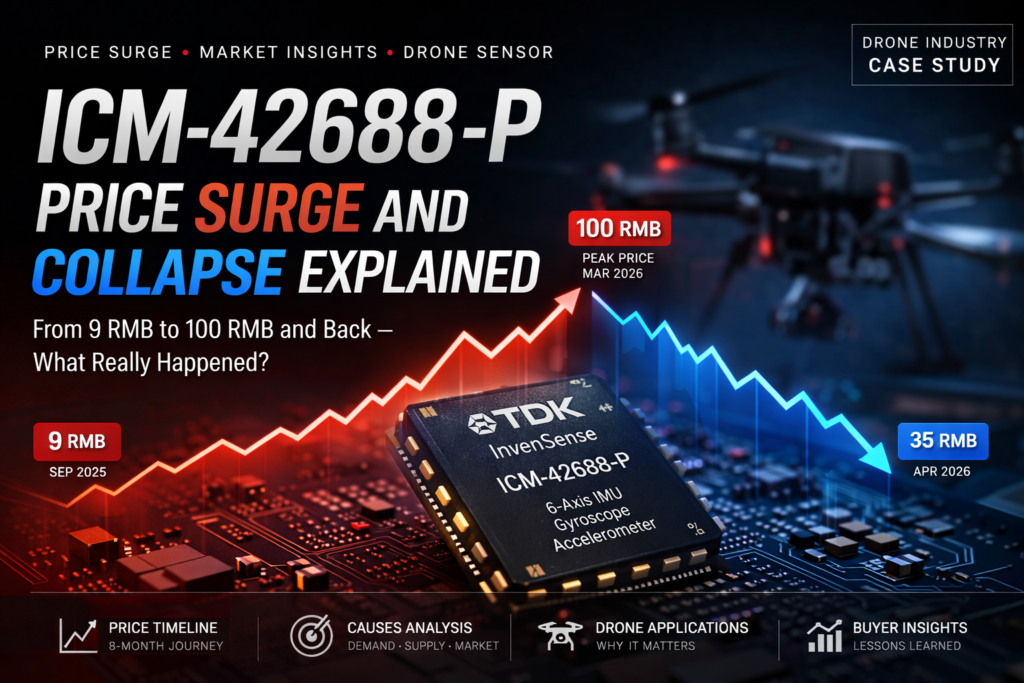
From under 10 RMB to nearly 100 RMB, and then dropping by half within a week — the price movement of ICM-42688-P over the past eight months has been anything but normal.
For many buyers, this wasn’t just a price fluctuation. It was a supply chain stress test.
Some secured stock early and benefited. Others are still holding high-cost inventory, waiting for the market to stabilize.
So what exactly happened?
This article breaks down:
- How ICM-42688-P became a “hot part number”
- What drove the extreme price surge
- Why the sudden price correction happened
- What buyers should learn from this cycle
1. What is ICM-42688-P?
ICM-42688-P, developed by TDK InvenSense, is a 6-axis IMU (Inertial Measurement Unit), integrating:
- 3-axis gyroscope
- 3-axis accelerometer
It is widely used in:
- FPV drones
- Robotics
- AR/VR devices
- Wearables
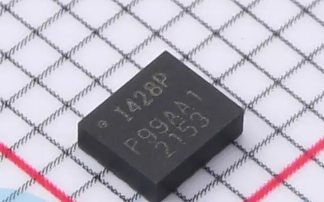
In drone flight control systems, gyroscope accuracy directly impacts flight stability and responsiveness.
In simpler terms:
This chip tells your drone how it is moving — rotation, tilt, acceleration — in real time.
And if that data is off, your drone doesn’t “fly.” It drifts, shakes, or crashes.
2. Price Timeline: From 8 RMB to 100 RMB and Back
Phase 1 — Early Signals (Sep 2025)
- Price: ~9 RMB → 10–13 RMB
- Inquiry volume increased
- Market inventory began shrinking
At this stage, most people ignored it. Classic mistake.
Phase 2 — Awareness Builds (Nov 2025)
- Price: 23–28 RMB
- Market attention increased
- More buyers realized its importance in drone BOMs
Phase 3 — Temporary Stabilization (Dec 2025)
- Price stabilized around 25 RMB
- Buyers resisted further increases
- Supply-demand entered a short standoff
Phase 4 — Market Frenzy (Jan–Mar 2026)
- Price surged to 70–100 RMB
- Lead time extended from 30 weeks → 45 weeks
- Alternative parts (like ICM-42607-P) also increased
This wasn’t rational pricing anymore. This was momentum + panic buying.
Phase 5 — Sudden Correction (Late Mar 2026)
- News of large incoming supply (hundreds of thousands of units)
- Price dropped by ~50% within one week
- Current range: 30–40 RMB
Translation: liquidity returned, and speculation collapsed.
3. Why Did ICM-42688-P Surge So Hard?
In distribution markets, price spikes usually come from three triggers:
1. External disruptions
(Natural disasters, geopolitical issues)
2. Market manipulation
(Hoarding, speculation)
3. Demand explosion
ICM-42688-P clearly falls into the third category.
3.1 Demand Explosion from FPV Drone Market
- FPV drone demand increased significantly in late 2025
- Overseas orders surged
- Buyers started sweeping available stock
At the same time:
- Inventory visibility dropped sharply across platforms
3.2 Technical Replacement Cycle
Historically:
- MPU6000 was the industry standard (pre-2022)
Then alternatives appeared:
- ICM20689
- BMI270
But none became a perfect replacement.
From 2023 onward:
- ICM-42688-P gained traction
- Better performance
- Acceptable pricing
- Eventually recommended by Betaflight (major FPV firmware)
Once Betaflight endorsed it, adoption accelerated fast.
3.3 High Switching Cost
Changing a sensor in drone design is not trivial:
- Re-validation cycle: 3–6 months
- Firmware tuning required
- Flight stability risks
So even if prices rise, manufacturers don’t switch immediately.
They endure.
3.4 Supply Constraints
- Lead time extended to ~45 weeks
- Original factory tightened supply
- Authorized channels reduced availability
Meanwhile:
Demand ↑
Supply ↓
Price going up wasn’t surprising. It was inevitable.
3.5 Market Amplification Effect
By early 2026:
- Multiple chip categories were already rising
- Market sentiment turned aggressive
- New traders entered just to “catch the wave”
ICM-42688-P became a “hot part number” not just because of demand, but because of attention.
And attention, in this industry, is basically fuel.
4. Why Did the Price Crash?
Simple. The story ran out of tension.
Key trigger:
- Previously placed orders started arriving
- Market heard about large incoming supply
Once confidence flipped:
- Buyers stopped chasing
- Sellers rushed to offload
- Price corrected rapidly
This is how most chip bubbles end:
Not slowly. Violently.
5. What This Means for Buyers
ICM-42688-P is not an isolated case.
Every year, one or more components go through this exact cycle:
- Tight supply
- Demand spike
- Price surge
- Panic buying
- Sudden correction
If you’re sourcing for production, the lesson is painfully obvious:
Price is not the biggest risk.
Uncertainty is.
6. How to Avoid Getting Trapped Next Time
A few practical strategies:
1. Monitor early signals
Small price increases + shrinking inventory = early warning
2. Secure supply before peak
Waiting for “confirmation” usually means paying peak price
3. Evaluate alternatives early
Even if you don’t switch immediately, keep backup options ready
4. Work with flexible suppliers
When the market moves fast, rigid sourcing models fail
At 7SEtronic, we help customers:
- Track hot part numbers early
- Secure stable supply channels
- Provide alternative solutions when needed
In volatile markets, sourcing is not just purchasing.
It’s risk management.
Conclusion
ICM-42688-P went from a standard 9 RMB component to a speculative asset, and then back toward reality — all within eight months.
It wasn’t the first such case. It won’t be the last.
Because in the semiconductor spot market, cycles don’t disappear.
They repeat.
The only difference is who gets caught in them next time.
FAQ
Q1: Is ICM-42688-P still in high demand?
Yes. Demand remains strong, especially in drone applications, though prices have stabilized.
Q2: Can it be easily replaced?
Not easily. Alternatives exist, but require validation and firmware adjustment.
Q3: Will prices rise again?
Possible, but depends on supply consistency and demand trends.
- NVIDIA Rubin BOM Analysis: What Component Buyers Need to Know Before the Next AI Hardware Wave
- Semiconductor Traceability vs Date Code: Can Older IC Inventory Still Be Reliable?
- From Components Sourcing to PCB Assembly: How 7SEtronic Supports OEM & EMS Projects
- Infineon Earnings Report: What OEM and EMS Buyers Need to Know About the 2026 Chip Market
- ICM-42688-P Price Surge Explained: From 9 RMB to 100 RMB and Back