
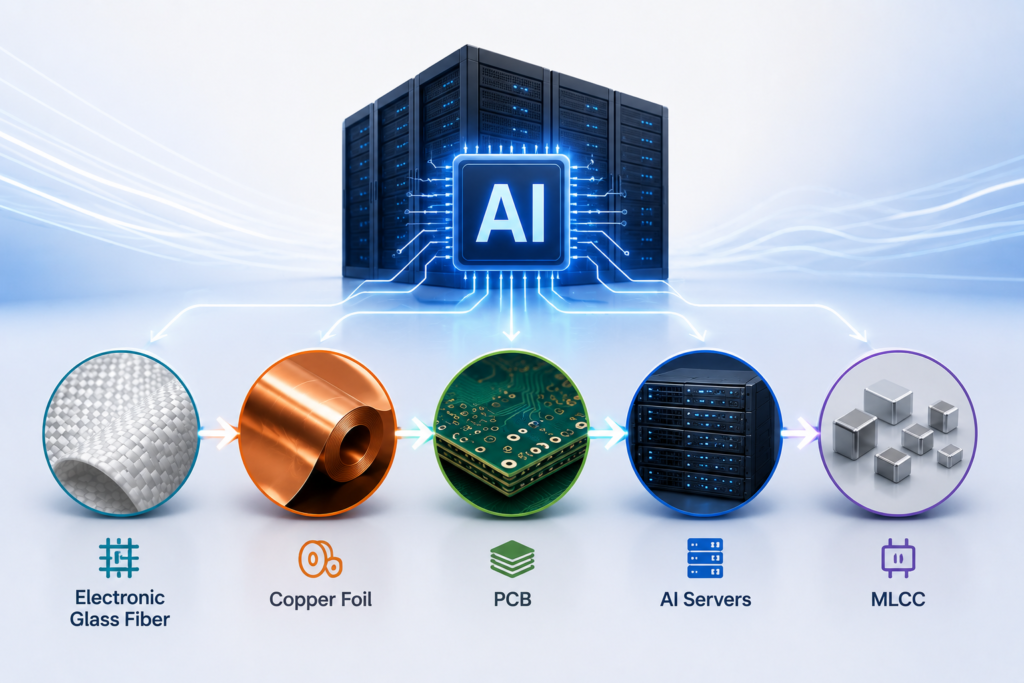

AI Is No Longer Just Driving GPU Demand
When people discuss artificial intelligence, most attention goes to GPUs, memory, and networking equipment.
However, the rapid growth of AI infrastructure is affecting a much larger ecosystem behind the scenes.
The AI server supply chain now extends far beyond semiconductors. It includes raw materials, PCB manufacturing technologies, passive components, and advanced electronics materials that are becoming increasingly critical to the success of modern AI systems.
In 2026, four industries have become tightly connected through the expansion of AI infrastructure:
- Electronic Glass Fiber
- Copper Foil
- PCB Manufacturing
- MLCC
Although these products belong to different segments of the electronics industry, they now share the same demand driver: AI servers.
As AI server deployments continue accelerating worldwide, supply pressure is spreading throughout the entire AI server supply chain.
The Supply Chain Behind Every AI Server
Every AI server begins with materials that most people never see.
The relationship can be simplified as:
Electronic Glass Fiber
↓
Copper Foil
↓
PCB Manufacturing
↓
AI Servers
↓
MLCC
AI demand pushes pressure upstream, while supply constraints flow downstream.
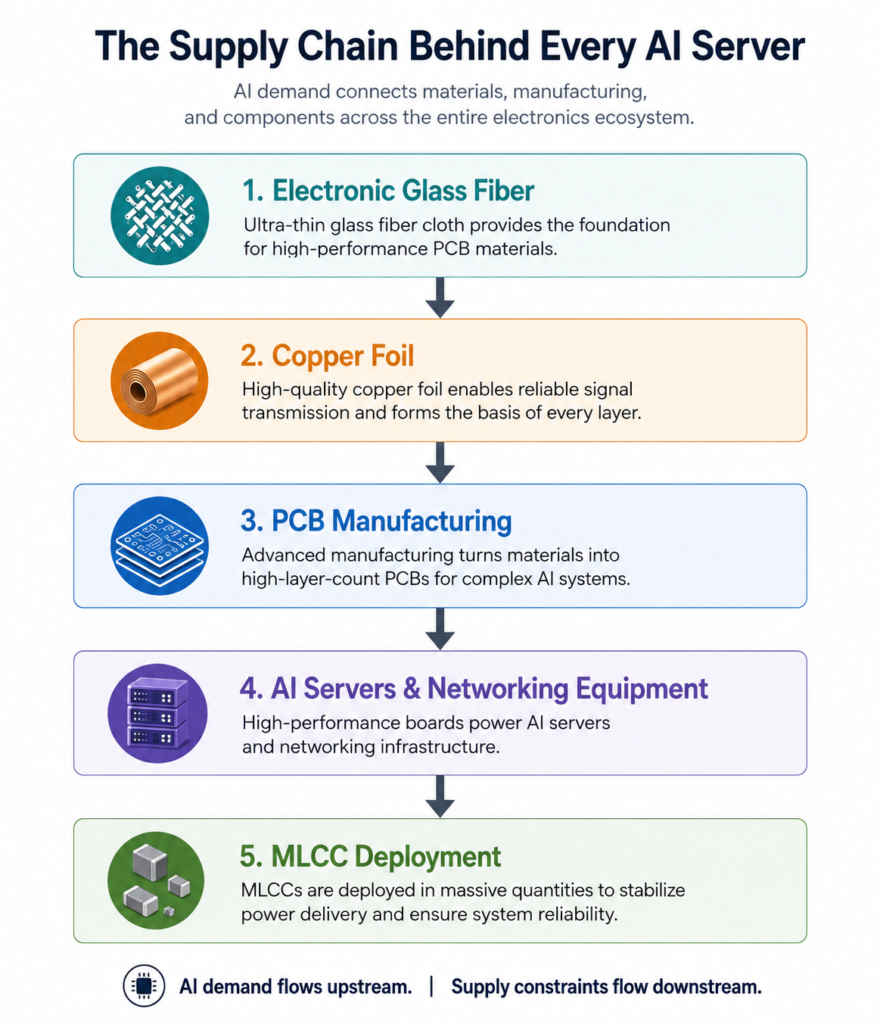
This means shortages in electronic glass fiber or copper foil can eventually affect PCB manufacturing capacity, which then influences AI server production and component demand.
Understanding this chain is becoming increasingly important for procurement teams, EMS companies, and OEM manufacturers.
Electronic Glass Fiber: The Hidden Foundation of the AI Server Supply Chain
Electronic glass fiber is one of the least visible but most important materials in the AI server supply chain.
Glass fiber cloth forms the structural foundation of copper-clad laminates (CCL), which are later used to manufacture PCBs.
As AI server PCB designs become more complex, manufacturers require thinner and more uniform glass fiber materials.
Compared with traditional server applications, AI server boards often contain significantly more layers and tighter signal integrity requirements.
This creates demand for:
- Ultra-thin electronic glass fiber
- Improved dimensional stability
- Better thermal performance
- Higher manufacturing precision
The challenge is that production capacity cannot be expanded quickly.
Manufacturing ultra-thin electronic glass fiber requires years of process optimization and qualification. New capacity often takes multiple years to reach commercial scale.
As a result, electronic glass fiber is becoming one of the first bottlenecks in the AI server supply chain.
Copper Foil: The Critical Material Behind High-Speed AI Server PCB Designs
Copper foil is the next essential material in the AI server supply chain.
After being bonded to the substrate, copper foil forms the conductive pathways used throughout the PCB.
Modern AI servers operate at extremely high frequencies.
At these speeds, even minor surface irregularities can cause signal degradation and transmission losses.
To overcome these challenges, PCB manufacturers increasingly rely on:
- HVLP Copper Foil
- Ultra Low Profile Copper Foil
- Advanced surface treatment technologies
The demand for high-end copper foil continues rising alongside AI infrastructure investments.
However, copper foil production faces two major constraints:
- Limited high-end manufacturing capacity
- Dependence on high-purity copper raw materials
Because of these factors, copper foil has become one of the most strategically important PCB materials in the AI server supply chain.
PCB Manufacturing: Where Material Constraints Become Delivery Constraints
PCB manufacturing sits at the center of the AI server supply chain.
It is where advanced materials are transformed into the high-performance boards required for AI servers and networking equipment.
Compared with conventional server platforms, AI server PCBs often require:
- More than 20 layers
- High-Tg materials
- Advanced drilling technologies
- Tight registration tolerances
- Superior signal integrity
Many people assume PCB capacity is determined by factory equipment alone.
In reality, the biggest limitation often comes from material availability.
PCB manufacturers can only expand output when they secure sufficient supplies of:
- High-Tg laminates
- HVLP copper foil
- Specialty resin systems
- Advanced PCB materials
This is why PCB lead times increasingly depend on material allocation rather than production equipment.
For many OEMs and EMS companies, PCB manufacturing has become one of the most critical stages within the AI server supply chain.
Why MLCC Demand Is Exploding Across AI Infrastructure
MLCCs have quietly become one of the biggest beneficiaries of AI infrastructure growth.
While GPUs receive most of the attention, MLCCs play an essential role in maintaining stable power delivery.
Their functions include:
- Filtering
- Decoupling
- Voltage stabilization
- Noise suppression
A modern AI server can contain tens of thousands of MLCCs.
Large AI racks may require hundreds of thousands of MLCCs to ensure stable operation under rapidly changing power loads.
As GPU power consumption continues increasing, MLCC demand rises accordingly.
The global MLCC market remains highly concentrated among a small number of major manufacturers.
Many suppliers are prioritizing:
- AI servers
- Automotive electronics
- High-reliability industrial applications
As capacity shifts toward these markets, certain industrial and consumer-grade MLCC categories are experiencing tighter supply conditions.
For procurement teams, MLCC availability is becoming a major consideration across the AI server supply chain.
Why These Four Industries Are Becoming Interconnected
At first glance, electronic glass fiber, copper foil, PCB manufacturing, and MLCC production appear unrelated.
The growth of AI infrastructure is changing that.
Every new generation of AI servers requires:
- Higher processing power
- Faster signal transmission
- Greater power density
- More advanced thermal management
These requirements push every layer of the electronics manufacturing ecosystem toward higher performance standards.
As demand increases, supply constraints begin appearing throughout the AI server supply chain.
The most important bottlenecks often occur at the material level because:
- Qualification cycles are lengthy
- Supplier concentration is high
- Capacity expansion requires years
- Technical barriers remain significant
This makes upstream materials increasingly important for future AI server production.
What Procurement Teams Should Watch in 2026
Companies operating within the AI server supply chain should pay close attention to several key areas.
High-Capacitance MLCC
Demand continues increasing due to AI servers and automotive electronics.
HVLP Copper Foil
Production capacity remains limited worldwide.
High-Layer PCB Manufacturing
AI server demand continues absorbing premium PCB capacity.
High-Tg PCB Materials
Material availability directly affects manufacturing lead times.
Multi-Source Procurement Strategies
Relying on a single supplier may increase supply chain risk during periods of tight market conditions.
Early planning remains one of the most effective ways to mitigate procurement challenges.
Final Thoughts
The impact of AI infrastructure extends far beyond GPUs and memory devices.
Electronic glass fiber, copper foil, PCB manufacturing, and MLCC components are becoming increasingly interconnected through the rapid expansion of the AI server supply chain.
As AI adoption accelerates globally, material availability and manufacturing capacity will play a larger role in determining how quickly the industry can scale.
For OEMs, EMS providers, and procurement professionals, understanding the AI server supply chain is no longer optional. It is becoming an essential part of effective sourcing, risk management, and long-term production planning.
At 7SEtronic, we continuously monitor global electronic components, PCB materials, MLCC markets, and supply chain developments to help customers reduce sourcing risks and secure critical materials before shortages affect production schedules.
FAQ
How does AI infrastructure impact the electronics supply chain?
The rapid expansion of AI infrastructure is increasing demand for advanced PCB materials, copper foil, electronic glass fiber, and MLCCs. This creates additional pressure on manufacturing capacity and lead times across the supply chain.
Why are MLCCs becoming more important in AI servers?
AI servers consume significantly more power than traditional computing systems. MLCCs help stabilize power delivery, filter noise, and protect sensitive components, resulting in much higher capacitor usage per server.
What should procurement teams monitor in the AI server supply chain?
Key areas include high-layer PCB capacity, HVLP copper foil availability, high-Tg PCB materials, and MLCC lead times. Early planning and diversified sourcing strategies can help reduce supply chain risks.
Others also view:
- How the AI Server Supply Chain Is Reshaping PCB, MLCC, Copper Foil and Electronic Glass Fiber Markets
- Top 12 Global MLCC Manufacturers in 2026: Financial Performance, Market Position and Supply Chain Trends
- NVIDIA Rubin BOM Analysis: What Component Buyers Need to Know Before the Next AI Hardware Wave
- Semiconductor Traceability vs Date Code: Can Older IC Inventory Still Be Reliable?
- From Components Sourcing to PCB Assembly: How 7SEtronic Supports OEM & EMS Projects