You’re buying electronic components in 2026 and still trusting a random PDF someone emailed you. Brave. Let’s tighten that up.
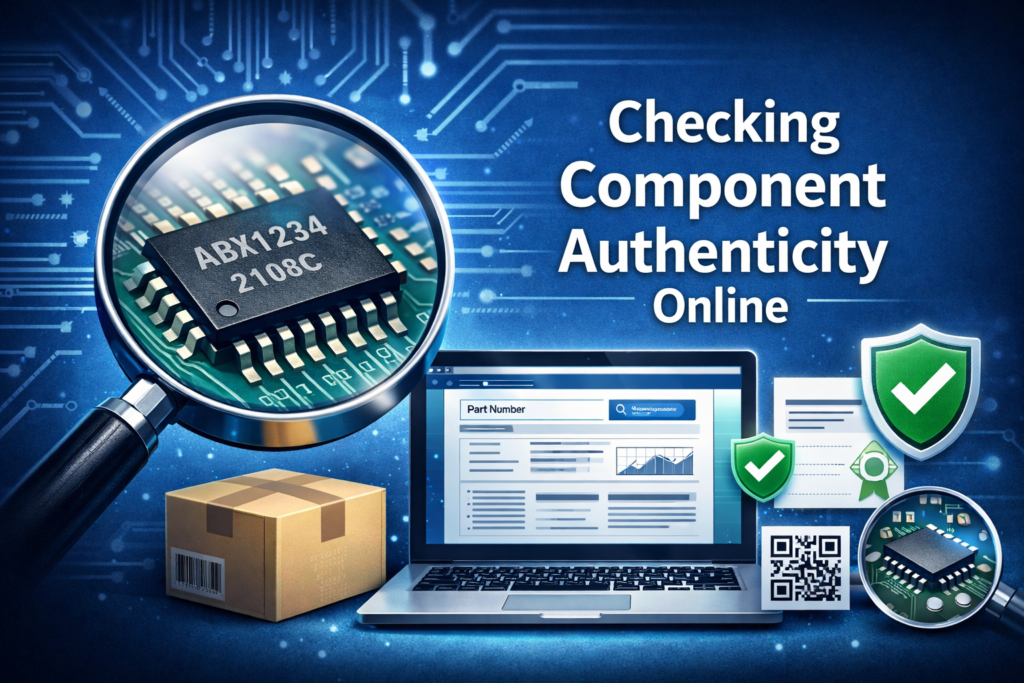
If you’re sourcing for overseas production, especially as a small or mid-sized factory, checking component authenticity online is no longer optional. Counterfeit ICs, relabeled chips, and recycled components are not rare accidents. They are structured businesses.
Ensuring component authenticity directly affects yield rate, product reliability, warranty cost, and brand credibility. A single batch of non-authentic components can quietly destroy months of production planning.
This guide breaks down the online verification process into structured steps that procurement teams can execute before issuing a PO.
1. Verify Manufacturer Information Directly from Official Sources
The first step in checking component authenticity online is confirming whether the part number actually exists in the manufacturer’s official database.
What to do:
- Visit the official website of the brand (e.g., TI, ST, NXP, Infineon, etc.)
- Search the exact part number
- Compare:
- Package type
- Temperature range
- Marking format
- Lifecycle status (Active / NRND / EOL)
- Revision history
Red Flags:
- The part number does not appear in official search results
- Marking code differs from datasheet marking guide
- Status shows EOL, but supplier claims “new production”
Many counterfeit cases begin with discontinued parts being “magically available” in large quantities.
For overseas factories, lifecycle status is especially critical. Using EOL components increases the probability of entering grey markets where authenticity risk multiplies.
2. Cross-Check Authorized Distribution Channels
Most major manufacturers list authorized distributors on their official websites.
Why this matters:
Authorized distributors source directly from the manufacturer. The traceability chain is clean.
When checking component authenticity online:
- Confirm whether the seller is listed as an authorized distributor
- If not authorized, request full traceability documents
- Ask for original manufacturer invoice reference (sensitive data can be masked)
For small and medium overseas factories balancing cost and risk, working with structured suppliers like 7setronic (click to see their SOP for quality checking of components) who can provide traceability documentation reduces exposure without sacrificing flexibility.
3. Request and Verify Date Codes and Lot Codes
Date codes and lot codes are not decorative numbers. They are traceability anchors.
Online Verification Steps:
- Request high-resolution photos of:
- Top marking
- Bottom marking
- Packaging label
- Moisture Sensitivity Level (MSL) label
- Compare font style and laser marking depth with known genuine samples
- Check whether date code aligns with lifecycle status
Example:
If a microcontroller was discontinued in 2021, but supplier offers 2024 date code stock, that deserves investigation.

Consistency between:
Barcode style
is often where counterfeit detection starts.
Label format
Reel structure
Vacuum packaging
4. Compare Pricing Against Market Benchmarks
Extreme price deviation is not a “good deal.” It is usually a warning.
When checking component authenticity online:
- Compare pricing across multiple global platforms
- Check historical price trends
- Evaluate whether supply shortage conditions justify pricing
If a component is under allocation globally, yet a supplier offers unlimited stock at 30% below market price, probability theory alone suggests caution.
Stable, realistic pricing aligned with market supply conditions is more trustworthy than dramatic discounts.
5. Use Third-Party Inspection & Testing Reports
For medium or high-value orders, authenticity verification should not rely only on visual checks.
Consider requesting:
- X-ray inspection reports
- Decapsulation analysis (for high-risk ICs)
- Solderability testing results
- Electrical parameter test reports
Many professional suppliers can coordinate third-party lab testing like White Horse Lab before shipment.
For overseas factories managing production risk remotely, this additional step significantly reduces failure probability in SMT lines.
6. Evaluate Supplier Behavior, Not Just Documents
Component authenticity risk is often behavioral.
Indicators of higher reliability:
- Willingness to provide detailed documentation
- Clear explanation of supply source
- Consistent communication
- No pressure tactics for urgent payment
- Structured quotation format
High-risk signals:
- Refusal to share photos
- Vague answers about sourcing
- Urgent “today only” pricing pressure
- Inconsistent company registration details
Professional suppliers understand that authenticity concerns are normal and provide structured responses.
7. Confirm Storage and Handling Conditions
Even genuine components can become unreliable if improperly stored.
When verifying online, request confirmation of:
- Humidity-controlled warehouse
- Anti-static packaging
- MSL compliance
- Shelf life management system
Authenticity is not just about being genuine. It is also about being production-ready.
A Practical Risk-Based Approach for Small Overseas Factories
Not every component requires laboratory-level authentication. Risk management should match application level.
High-risk scenarios:
- Automotive electronics
- Industrial control systems
- Medical devices
- High-frequency communication modules
Lower-risk scenarios:
- Consumer electronics prototypes
- Low-volume R&D batches
Structured sourcing partners such as 7setronic can support factories by combining market sourcing flexibility with documentation-backed traceability. This hybrid model helps reduce authenticity risk while maintaining cost control.
Conclusion: Authenticity Verification Is a Process, Not a Single Check
Checking component authenticity online is not about one document or one screenshot. It is a layered validation process:
- Manufacturer verification
- Distribution channel confirmation
- Code and marking consistency
- Pricing rationality
- Optional third-party testing
- Supplier credibility evaluation
- Storage compliance
For overseas factories operating across time zones and relying on cross-border procurement, implementing a structured authenticity checklist reduces production interruption, RMA rates, and brand damage.
A disciplined sourcing process may look conservative, but in reality, it protects profit margins and delivery schedules.
If your team needs structured support in verifying component authenticity or managing traceable sourcing for upcoming production, 7setronic can assist with documentation-backed supply and inspection coordination to help reduce procurement uncertainty.
FAQ
1. Can datasheets alone confirm component authenticity?
No. Datasheets verify specifications, not the physical origin of supplied parts.
2. Is buying from brokers always risky?
Not always, but traceability documentation becomes more critical.
3. Are lower prices always counterfeit signals?
Not always, but significant deviation from market levels requires investigation.